

Dear Readers,
This week in Asia, Washington delivered its clearest deterrence signal yet to Beijing, pushing ahead with a record $11.1 billion arms package for Taiwan as China stepped up pressure across the Taiwan Strait. Elsewhere in the region, fighting reignited along the Thailand–Cambodia border, triggering mass displacement and chemical-weapons accusations, while China’s economy showed fresh signs of strain even as Beijing quietly pressed ahead with its drive for semiconductor self-sufficiency.
U.S. Pushes Ahead With Record $11.1bn Arms Sale to Taiwan
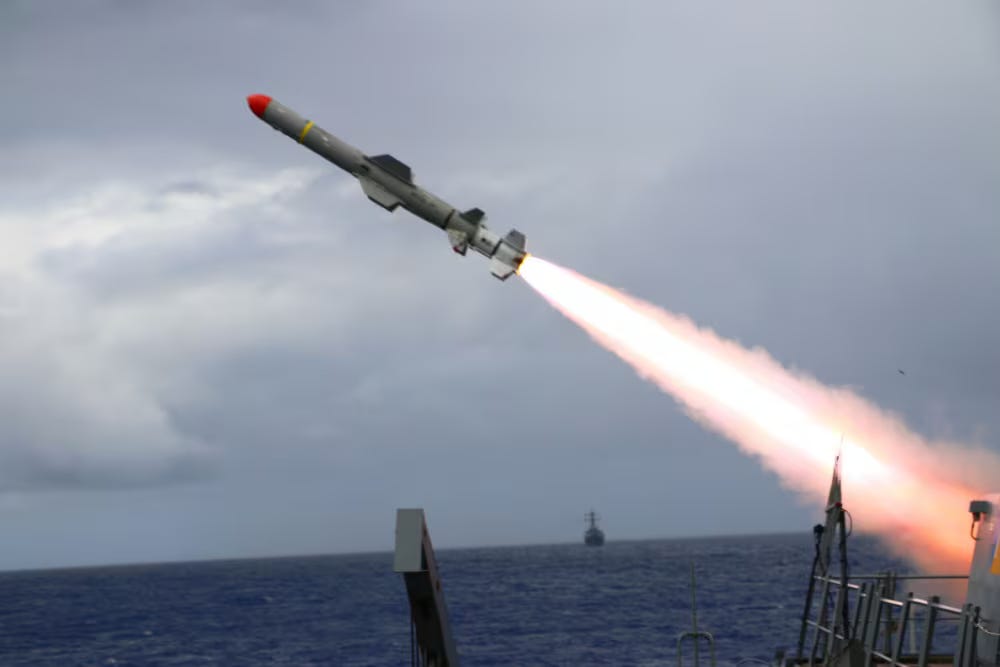
Washington is moving ahead with an $11.1 billion arms package for Taiwan, the largest U.S. weapons sale ever approved for the island. Taiwan’s defense ministry confirmed the deal on Thursday, saying it has entered the Congressional notification phase. It’s also the second Taiwan arms sale under Donald Trump’s current administration, signalling that U.S. security support for Taipei remains firmly on track despite rising pressure from Beijing.
The package includes HIMARS rocket systems, howitzers, anti-tank missiles, drones, and spare parts, all aligned with Taiwan’s push toward asymmetric warfare—mobile, survivable systems designed to deter a much larger PLA force. Taipei framed the sale as critical to building credible deterrence and maintaining stability in the Taiwan Strait.
The timing matters. China has stepped up military and diplomatic coercion against Taiwan, even as Washington balances formal ties with Beijing and its legal obligation to help Taiwan defend itself. Despite regional anxieties over Trump’s deal-driven style and a planned Xi–Trump meeting next year, U.S. officials have made clear they intend to ramp up arms sales beyond Trump’s first term. For now, this package sends a clear message: deterrence, not retreat, remains U.S. policy on Taiwan.
The proposed sale encompasses a diverse range of long-range strike capabilities, precision firepower, and sustainment—squarely aligned with Taiwan’s asymmetric defense items include:
82 HIMARS launchers and 420 ATACMS missiles, bundled in a package worth over $4 billion, giving Taiwan a significant boost in long-range, mobile strike capability.
60 self-propelled howitzer systems and related equipment, valued at more than $4 billion, strengthening artillery firepower and survivability.
Unmanned aerial vehicle (UAV) systems, valued at over $1 billion, expanding ISR and strike options.
Military software worth more than $1 billion, supporting command, control, and battlefield integration.
Javelin and TOW anti-tank missiles, combined value of over $700 million, reinforcing close-range and coastal defense.
Helicopter spare parts worth $96 million, aimed at improving readiness and sustainment.
Refurbishment kits for Harpoon anti-ship missiles, valued at $91 million, extending the life of existing coastal defense assets.
Escalation on the Thailand–Cambodia Border
Heavy clashes renew displacement and casualties. Fighting between Thai forces and Cambodian troops along the border intensified, breaking an earlier cease‑fire. Reuters reports that by 14 Dec the conflict had killed around 40 people and displaced more than 500 000 civilians. Thailand’s caretaker prime minister, Anutin Charnvirakul, vowed to continue combat operations even as former U.S. President Trump claimed to have brokered a ceasefire. Cambodia accused Thailand of using rockets and claimed Thai F‑16s struck coastal areas, while Thai officials countered that Cambodian forces fired first and used rockets near Thai villages.
Humanitarian and economic fallout: Thailand closed its main border crossing at Chong Mek, leaving about 6 000 Thai citizens stranded in Cambodia. The government explored halting fuel exports to Cambodia to prevent supplies from being diverted to the Cambodian military. Southeast Asian foreign ministers planned emergency talks to negotiate a cease‑fire.
Chemical‑weapons accusations: Cambodian soldiers complained of respiratory problems after Thai aircraft allegedly dispersed “toxic gas.” Cambodia accused Thailand of using chemical weapons, but Thai officials dismissed the claims as fake news. Cambodia previously accused Thailand of employing white phosphorus; exposure to those fumes can severely damage respiratory tracts.
China’s Economic Headwinds and Semiconductor Drive
China’s economy softened in November: industrial output growth fell to a 15‑month low and retail sales growth slowed to the weakest pace since 2022, reflecting fading consumer subsidies and the property crisis. The property sector, which accounts for about 70 % of household wealth, continued to decline with investment down 15.9 % year‑on‑year. International bodies, including the IMF, urged Beijing to implement structural reforms and resolve the property debt overhang.
Youth unemployment remained high: China’s jobless rate for 16‑ to 24‑year‑olds was 16.9 % in November, while unemployment among 25‑ to 29‑year‑olds was 7.2 %.
A Reuters investigation revealed that Chinese engineers have assembled a prototype extreme‑ultraviolet (EUV) lithography machine in Shenzhen. Built from salvage parts and taking up an entire factory floor, the prototype has not yet produced chips but generates EUV light and demonstrates Beijing’s drive to achieve chip self‑sufficiency by 2028–2030. EUV machines, currently monopolized by ASML, are essential for manufacturing cutting‑edge semiconductors, and Washington’s export controls aim to restrict China’s access.
Reads:
How China Wins the Future — Elizabeth Economy
Dispatch from New Delhi: Another India-China flare-up is coming — Michael Kugelman and Srujan Palkar
China’s dispute with India over Arunachal Pradesh — Victoria Jones