

Cross‑Strait Monitor: What’s New and What’s Familiar in China’s Latest Drills
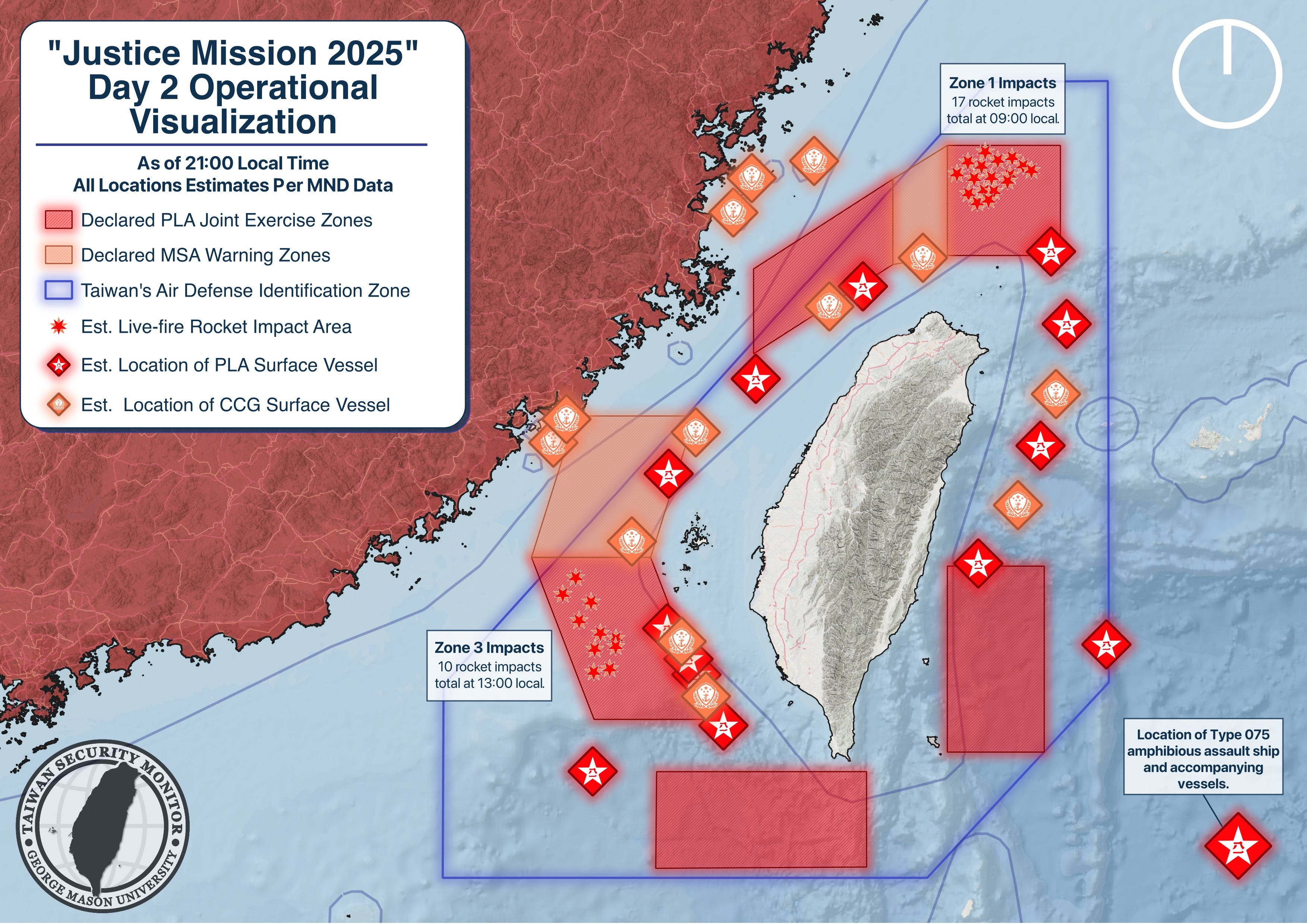
Source: Taiwan Security Monitor
China’s People’s Liberation Army (PLA) closed out 2025 by staging the most extensive set of military drills yet around Taiwan. Dubbed “Justice Mission 2025,” the exercises followed an 11.1 billion USD U.S. arms package for Taiwan and aimed to demonstrate Beijing’s ability to cut the island off from outside support.
Taiwan’s Ministry of National Defense detected nearly 90 PLA aircraft, 14 military vessels, and 14 coast-guard ships operating around the island on the first day of the drills. The exercises were part of a series of Chinese war games that have grown progressively more sophisticated since 2022.
This newsletter breaks down what was new about the latest drills and which elements follow patterns from previous exercises. It concludes with a brief look at why these developments matter for regional security.
What Was New in 2025
The Justice Mission 2025 drills departed from earlier exercises in several notable ways.
Record coverage and encirclement zones
Beijing’s Eastern Theater Command designated seven maritime zones for live-fire drills, more than any previous exercise. These zones encircled Taiwan more tightly and extended into eastern waters, making the drills “the largest to date by total coverage.” Taiwan’s coast guard noted that 35 PLA aircraft crossed the Taiwan Strait’s median line and that Chinese coast-guard vessels circled the island, highlighting a push to normalize incursions into areas once considered off-limits. An article published by China’s Xinhua news agency called the maneuvers an “encirclement” designed to “press and contain separatist forces while denying access to external interference,” summarized as “sealing internally and blocking externally.” Previous PLA exercises were large but seldom attempted such a comprehensive blockade.
Targeting of ports and energy corridors
Propaganda posters released during the drills highlighted attacks on Keelung and Kaohsiung, Taiwan’s largest ports. State media emphasized that the exercises aimed to seal off vital deep-water ports. Videos also depicted precision strikes on simulated energy facilities and supply routes, accompanied by captions such as “control energy corridors, disrupt supply routes, block clandestine routes to docks.” The focus on chokepoints and energy infrastructure marked a shift from earlier drills that concentrated primarily on air and missile strikes.
Showcase of emerging technologies
The PLA released footage showing automated humanoid robots, swarms of micro-drones and weaponized robotic dogs attacking mock targets. This was the first time China publicly showcased such technologies in cross-strait exercises. The display underscored Beijing’s interest in unmanned systems as part of future amphibious assaults and psychological warfare.
Integration of civilian shipping
Chinese state television highlighted an “armada of civilian ships” mobilized to support amphibious operations, with ramps and open decks suitable for transporting vehicles. Previous exercises used military landing ships, but the incorporation of commercial vessels demonstrates how the PLA might augment lift capacity in a conflict.
Emphasis on multi-domain blockade and distant strikes The April 2025 “Strait Thunder 2025A” drills, a precursor to Justice Mission 2025, already tested long-range live-fire rocket drills in the East China Sea and involved the aircraft carrier Shandong. Justice Mission expanded on this by simulating precision strikes on ports and energy facilities and by rehearsing multi-dimensional blockade and control, including strikes beyond the Taiwan Strait and into the Western Pacific. Analysts noted that the drills blurred the line between routine training and preparation for an actual assault.
What Looked Familiar
Despite these innovations, many aspects of the 2025 exercises echoed earlier PLA war games.
Continuing blockade and encirclement scenarios
Since the August 2022 drills triggered by former U.S. House Speaker Nancy Pelosi’s visit, Beijing’s exercises have consistently practiced blockade tactics. In 2022 China fired conventional missiles near Taiwan and deployed more than 100 aircraft and 10 warships. The inaugural Joint Sword 2023 drills in April 2023 encircled Taiwan and simulated strikes on key nodes. Joint Sword 2024A in May 2024 integrated PLA Navy ships with the China Coast Guard, demonstrating gray-zone tactics that blur military and law-enforcement roles. Joint Sword 2024B in October 2024 continued the encirclement and notional blockade scenarios; the aircraft carrier Liaoning operated east of Taiwan while 153 PLA aviation sorties were recorded. These recurring blockade drills created the template on which Justice Mission 2025 built.
Use of Coast Guard and paramilitary forces
Joint Sword 2024A saw the integration of China Coast Guard vessels with PLA forces, enhancing maritime law-enforcement resources to support military objectives. Coast-guard ships circumnavigated Taiwan during the 2024B exercise in a heart-shaped route portrayed by Chinese media as a “patrol of love.” Justice Mission 2025 continued this pattern by deploying 14 coast-guard vessels alongside the PLA.
Cross-Strait “punishment” motif Beijing has repeatedly framed exercises as punitive responses to political events—Pelosi’s visit in 2022, President Lai Ching-te’s inauguration in May 2024 and his National Day speech in October 2024. The China–Taiwan Weekly Update by the Institute for the Study of War notes that these drills often coincide with U.S. arms sales or Taipei’s engagements abroad, and that China uses them to signal both deterrence and retaliation. Justice Mission 2025 followed the same motif; the drills began 11 days after Washington announced a record U.S.$11.1 billion arms package for Taiwan.
Unannounced precision strikes and median-line crossings
Long-range strikes and aggressive aircraft maneuvers have become routine. In April 2025, the PLA’s Strait Thunder 2025A drills launched rockets and practiced strikes on ports and energy facilities. During Justice Mission 2025, Taiwan recorded 35 PLA aircraft crossing the Taiwan Strait’s median line—a practice that started in 2022 and continued through the Joint Sword series. PLA vessels also operated inside Taiwan’s contiguous zone, part of a “creeping territorial encroachment” identified by analysts.
Where Do These Trends Lead?
Analysts observe an evolution from politically triggered displays toward a sustained military presence. The U.S. Air University notes that PLA incursions into Taiwan’s airspace and waters surged in early 2025 even without major political flashpoints, setting record highs in median-line crossings and warship activity. These incursions extend beyond the Strait into the Bashi Channel and the Western Pacific, underscoring a doctrinal focus on operational dominance and training rather than simple signaling. Combined with demonstrations of new technology and multi-domain blockade tactics, Justice Mission 2025 suggests that Beijing is rehearsing both the isolation of Taiwan and the interdiction of foreign intervention.
Key Exercises and Their Characteristics
The evolution of China’s military posture around Taiwan is illustrated through several major exercises conducted between 2022 and 2025.
Pelosi-response Drills (August 2022): During these exercises, the PLA fired conventional ballistic missiles near Taiwan and established six distinct exercise zones involving over 100 aircraft and 10 warships. This marked the first large-scale encirclement since 1996 and established a new precedent by frequently crossing the Taiwan Strait’s median line.
Joint Sword 2023 (April 2023): These drills focused on a symbolic encirclement of the island and simulated precision strikes on key operational nodes. The exercise reinforced a growing pattern of “punishment” drills launched in response to perceived political provocations.
Joint Sword 2024A (May 2024): This iteration integrated the PLA Navy with the China Coast Guard to highlight gray-zone tactics and included operations near Taiwan’s offshore islands. While it continued previous blockade scenarios, it featured fewer aircraft than the 2023 drills and did not designate specific live-fire zones.
Joint Sword 2024B (October 2024): The PLA utilized the aircraft carrier Liaoning and recorded 153 aviation sorties while coast-guard vessels performed a full circumnavigation of the island. The exercises moved closer to Taiwan’s contiguous zone, maintaining the encirclement motif as a political message tied to President Lai’s National Day speech.
Strait Thunder 2025A (April 2025): These drills featured long-range live-fire rocket exercises in the East China Sea and specific targeting of ports and energy facilities using the aircraft carrier Shandong and YJ-21 air-launched ballistic missiles. Although no live fire was detected immediately near Taiwan, the exercise was a significant show of anti-access/area denial capabilities.
Justice Mission 2025 (December 2025): Representing the largest drills by coverage to date, this exercise utilized seven encirclement zones and focused on sealing off ports and energy corridors. It was notable for showcasing advanced technology like humanoid robots and micro-drones while mobilizing civilian shipping, all while continuing the established motif of punitive blockade and integrated coast-guard presence.
Conclusion
China’s Justice Mission 2025 drills represent both continuity and evolution in the PLA’s approach to Taiwan. The exercise built on a decade of escalation that began with ballistic-missile salvos in 2022 and evolved through the Joint Sword series’ blockade rehearsals. Yet it added new dimensions—record geographical coverage, explicit targeting of ports and energy infrastructure, integration of civilian shipping and high-profile use of unmanned systems—that hint at Beijing’s broader ambitions. Together with the shift toward sustained military presence noted by analysts, these innovations suggest the PLA is not merely signaling displeasure but rehearsing operational capabilities to isolate Taiwan and deter external intervention.
For Taipei and its partners, the challenge now lies in countering not just isolated spikes of activity but a steady drumbeat of incursions and a growing portfolio of technologies that could complicate defense planning. Continued transparency, international engagement and development of asymmetric capabilities—such as long-range precision fires highlighted in Taiwan’s recent U.S. arms package—will be critical to preserving stability in the Taiwan Strait.