

Hello Readers,
I wrote a new op-ed for Taipei Times about what China is thinking about the U.S.-Iran conflict. The conflict is stress testing the sanctions evasion regime Beijing built alongside Tehran: the shadow fleets to carry oil, the missile trade and other related materials.
The op-ed: Beijing has a three-body problem
Now the newsletter follows
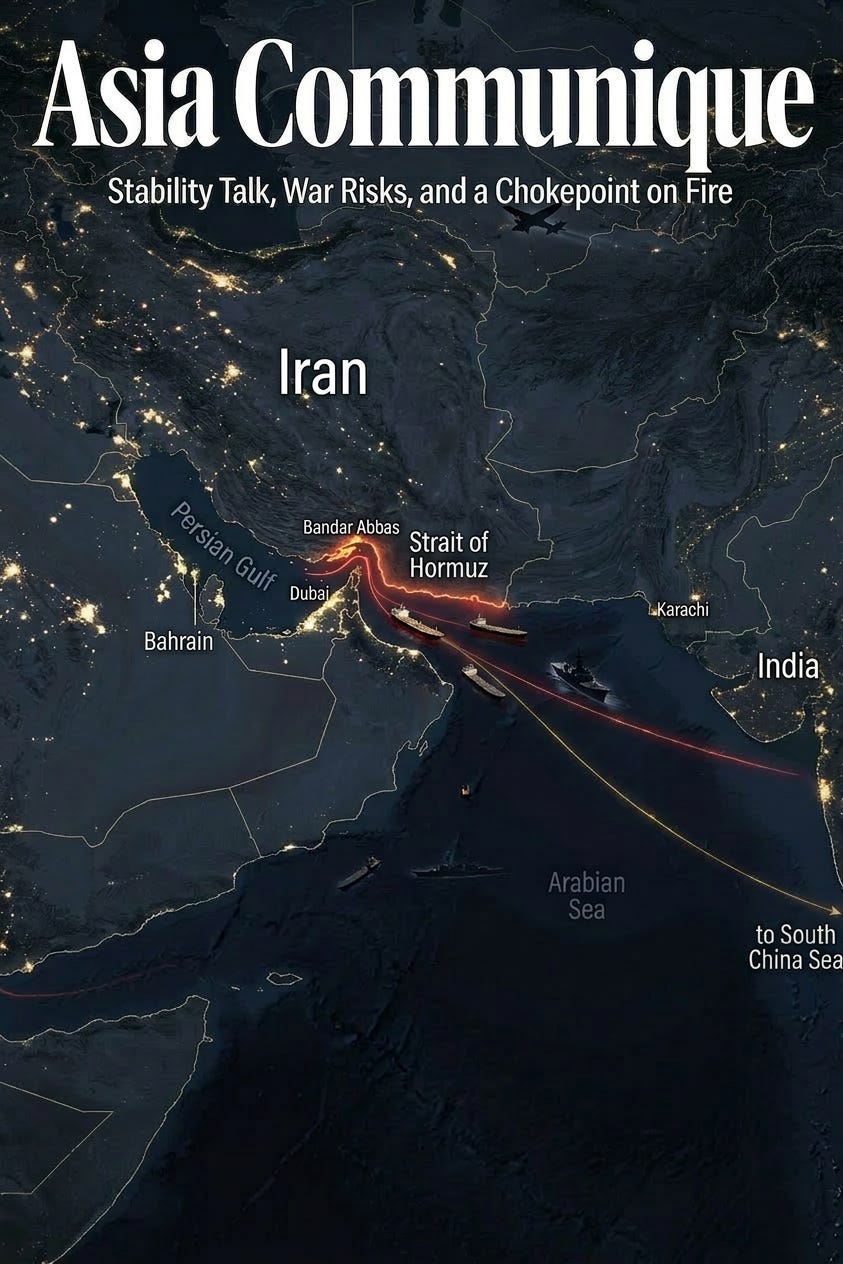
Washington and Beijing are busily talking about “stability” even as Asia’s strategic environment feels anything but stable. On one front, Donald Trump is heading to Beijing for a summit that’s supposed to calm U.S.–China tensions without really fixing anything. On another, the war with Iran has effectively choked off the Strait of Hormuz, triggering an energy shock that lands hardest in Asian capitals. Layer on China’s drills in the South China Sea, North Korean missile tests and Japan’s record defense budget, and you get a region that’s quietly preparing for a much rougher decade.
Let’s start in Beijing.
Trump–Xi: a summit about “not blowing things up”
Trump is currently slated to visit China from March 31 to April 2 — his first state visit to Beijing since 2017, and the first meeting with Xi Jinping since the two sides agreed on their latest trade truce last October. The official line from both capitals is that they want to “maintain stability” after years of tariffs, tech controls and bruising political rhetoric. But people involved in the planning are remarkably blunt: no one expects a real reset in business or investment ties.
On the U.S. side, corporate America hasn’t yet secured the big CEO delegation it hoped would hitch a ride on Air Force One, despite lobbying from Trump’s ambassador in Beijing, David Perdue. Trade officials in Washington are wary of turning the trip into a glitzy deal-signing jamboree; the Office of the U.S. Trade Representative wants to keep the focus on tightly managed purchase commitments, not a broader reopening that would be hard to walk back later.
Beijing, meanwhile, sees little sign that Washington is ready to offer the investment protections Chinese firms want after episodes like the forced restructuring of TikTok’s U.S. business. Chinese officials are also irritated by what they view as last-minute U.S. planning for a visit that, in the Chinese system, is usually scripted months in advance. As Brookings’ Ryan Hass put it, the ambition for the trip “seems to be getting smaller by the day” — which may be the point.
Even on tariffs, the best case is muddling through. The U.S. Supreme Court recently struck down a 10% tariff Trump had imposed on fentanyl-related imports under an emergency statute, and the administration is already signaling it will simply re-impose the same levy under a different law. Trade Representative Jamieson Greer insists the meeting “is not to fight about trade,” but rather to check that China is living up to existing purchase pledges and keeping rare earths flowing. That’s not a reset; that’s crisis management.
Rare earths and Boeings: commerce as leverage
Underneath the summit optics sit two very concrete bargaining chips: rare earths and airplanes.
First, rare earths. U.S. aerospace and chip suppliers are already grappling with tightening supplies of key elements such as yttrium and scandium, even after Beijing eased some of the export curbs it imposed last year. These materials are buried inside jet engine coatings, missiles and high-end semiconductors — precisely the sectors Washington labels “strategic.” Industry sources say some coating manufacturers have paused operations or turned away smaller customers because they simply cannot secure enough feedstock, even as prices spike. Officials publicly insist there’s no crisis, but privately concede that shortages are real.
That brings us to Boeing. Multiple reports suggest Boeing is close to sealing a blockbuster order for around 500 narrow-body jets, plus potential widebodies, to be wrapped in the aura of the Trump–Xi summit. The deal would help restart big Chinese orders after years of freeze and keep Chinese airlines tied into Boeing’s ecosystem well into the 2030s, given current production backlogs. Beijing, unsurprisingly, wants something in return: multi-year guarantees on parts and support, and perhaps relief from some export-control threats.
White House aides are reportedly split on whether to unveil everything in Beijing or hold some “wins” back for a future summit on U.S. soil. In other words, even commercial deals are now rationed and sequenced as geopolitical tools.
South China Sea: “routine drills” that aren’t routine
While officials talk up “stability,” the maritime picture is tense.
At the end of January, China’s Southern Theater Command launched naval and air “combat readiness” drills around Scarborough Shoal, a disputed reef in the South China Sea claimed by both Beijing and Manila. State-linked outlets highlighted the presence of H-6K bombers armed with anti-ship missiles and a Type 055 destroyer — a clear signal that this was more than a symbolic sail-by. Chinese statements framed the drills as a response to “provocations” by unnamed countries and part of efforts to “resolutely safeguard” sovereignty and maritime rights.
All this comes on the heels of repeated U.S.–Philippines exercises in nearby waters and a flurry of multinational drills involving the U.S., Japan, France and others. The emerging pattern: overlapping exercises, increasingly capable platforms on both sides and rising risk that one dangerous maneuver or collision creates the next crisis.
North Korea: missiles as punctuation marks
Further north, Pyongyang is once again using missile launches to punctuate regional diplomacy.
On January 3–4, North Korea fired several ballistic missiles into the sea off its east coast, with South Korea and Japan estimating ranges of around 900 km. The timing was deliberate, coinciding with South Korean President Lee Jae-myung’s state visit to China, where North Korea’s nuclear and missile programs were on the agenda.
Later in the month, North Korea followed up with additional suspected ballistic missile tests as it prepares for a rare ruling-party gathering. State media has presented these launches as part of efforts to expand and modernize the country’s “nuclear deterrent” amid what Kim Jong Un calls a worsening “geopolitical crisis.” For Beijing, they are an unwelcome reminder that it either cannot or will not rein in its neighbor. For U.S., Japanese and South Korean planners, they’re yet another argument for more missile defense, more exercises and deeper trilateral coordination.
Japan’s defense build-up becomes the new normal
Against this backdrop, Japan’s quiet but relentless military build-up is hard to ignore.
Tokyo has approved a record draft defense budget of more than 9 trillion yen (about 58 billion dollars) for fiscal 2026, continuing a multi-year push to reach roughly 2% of GDP in defense spending. Officials explicitly justify the increase as a response to China’s growing military power, North Korean missiles and Russia’s more active posture in the region.
The money is flowing into more than just big-ticket ships and jets. Tokyo is funding a multi-layered coastal “Shield” made up of thousands of drones and other unmanned systems to complicate any amphibious or gray-zone incursions, aiming for full deployment by the end of fiscal 2027. It is also investing heavily in a next-generation fighter program with the UK and Italy, along with AI-enabled “loyal wingman” drones, longer-range cruise missiles and looser export rules. Put together, this is a shift from self-defense minimalism to something much more forward-leaning.
If the Strait of Hormuz really closes
All of that, though, is happening as the world’s most important energy chokepoint — the Strait of Hormuz — becomes functionally unpassable for many tankers. The Iran war has turned what was once a recurrent scare story into a live disruption.
On a normal day, about 19–21 million barrels of oil and petroleum liquids move through Hormuz, roughly one-fifth of global consumption and more than a quarter of all seaborne oil trade. The strait is also a key artery for LNG, with about 20% of global volumes — dominated by Qatar — squeezing through its narrow waters. The U.S. Energy Information Administration and other trackers estimate that more than 80% of the crude and over 80% of the LNG passing Hormuz head to Asia, with China, India, Japan and South Korea together taking roughly 70% of the oil.
That exposure is now being priced in brutally. Since the effective closure of the strait, Brent and WTI have logged their sharpest weekly gains in years, and global benchmark gas prices have jumped as much as 40–50% in a single session, particularly as Qatar shutters production at major LNG facilities. Analysts are sketching scenarios in which oil spikes toward 130–150 dollars a barrel if the disruption persists, while some Gulf officials talk up even higher worst-case numbers.
For Asia’s big economies, the math is harsh. Japan still sources roughly 80–95% of its crude from the Middle East, most of it transiting Hormuz, and depends on fossil fuels for nearly 90% of its total energy use. China gets around half of its oil imports and about a third of its LNG from the Gulf, while India’s Middle East share runs in the 40–50% range; South Korea and smaller Southeast Asian states are similarly exposed. Strategic stockpiles buy time — Japan and South Korea have more than 200 days of cover, China perhaps three to four months, India around two months — but not an indefinite blockade.
There are workarounds, but none at the same scale. Some Saudi and Emirati crude can be pumped to Red Sea ports via pipelines, and Asian buyers can lean harder on Russian, U.S. and West African barrels. Yet a multi-million-barrel-per-day gap remains, especially for LNG, which simply cannot be rerouted around Hormuz the way some oil can. The result: tankers idling in the Gulf, war-risk insurance spiking, cargo diversions via longer and costlier routes, and major lines suspending bookings to key Middle Eastern ports except for essential goods.
Militarily, a choked Hormuz pulls Asian security forces deeper into Gulf waters. Gulf states are leaning on the U.S. Fifth Fleet and European navies for escorts, but Japan and South Korea — which have deployed assets to protect shipping before — will face pressure to step up again. China, whose tankers are among the biggest users of the strait, finds itself in the awkward position of relying on a waterway patrolled by U.S. forces even as it competes with Washington globally. For developing importers like Pakistan, Bangladesh and Thailand, the problem is even starker: they risk being outbid for cargoes altogether as richer economies hoard supplies.
In short, a sustained shutdown of Hormuz wouldn’t just be another oil price spike. It would be a structural shock that tests Asia’s energy-security strategies, accelerates diversification away from Gulf hydrocarbons where possible and hardens the case for bigger navies and more forward-deployed forces. The paradox is that as Asian capitals talk about “de-risking” their relations with the West, their most immediate risk still runs through a narrow channel between Iran and Oman.
What we’re watching next
A few storylines to track in the coming days:
Whether the Trump–Xi summit produces anything more than a Boeing mega-order, some farm purchases and vague stability language — and, just as important, what gets left out.
How explicitly Beijing links rare earths and other critical minerals to U.S. behavior on tariffs, export controls and Iran-related sanctions.
The tempo and intensity of Chinese and U.S.–allied drills in the South China Sea, especially around Scarborough Shoal.
Further North Korean tests as its party meeting approaches, particularly any new hypersonic or solid-fuel systems that compress warning times.
How quickly Japan and other Asian states move from energy shock management (stockpile releases, subsidies) to deeper structural shifts in defense and energy policy.
Everyone is talking about “stability” right now. But if you look at the drills, the budgets and the tankers stuck in the Gulf, Asia’s real story this week is nervous preparation for the next shock.
Countries in Asia are increasing their weapon purchases due to the perceived threat posed by China’s intentions:
https://x.com/NikkeiAsia/status/2030876641673548089
Thank you for reading!