
Japan Moves From Pacifist Constraint to Strategic Arms Policy
Japan has crossed an important threshold in its postwar security policy, formally opening the way for exports of lethal military equipment after scrapping the “five category” rule that had long confined defense transfers to non-combat uses.
The legal change matters less for its bureaucratic wording than for what it signals: Tokyo no longer sees defense exports as an embarrassing exception to be narrowly managed, but as a strategic necessity. The old framework reflected a Japan still constrained by postwar political instincts. The new one reflects a Japan that believes the regional balance has deteriorated enough to justify treating its defense industry as part of national power.
Under the revised Three Principles on the Transfer of Defense Equipment and Technology, exports will now be judged through a new distinction between “weapons” and “non-weapons.” Major systems such as destroyers and submarines will still require National Security Council approval, and transfers will be limited to 17 countries with existing defense equipment agreements, including the Philippines and Indonesia. But the larger shift is clear: the default posture has changed from avoidance to conditional enablement.
Tokyo is justifying the move on two grounds. The first is industrial. A defense sector that cannot export is expensive to maintain, hard to scale, and vulnerable in any prolonged contingency. The second is geopolitical. If Japan wants tighter security cooperation with like-minded states, shared equipment and supply networks matter. Interoperability is not just about joint exercises; it is also about whether partners can sustain operations with compatible platforms and components when a crisis actually comes.
Prime Minister Sanae Takaichi’s insistence that Japan remains a peace-oriented nation is politically necessary, but it also misses the deeper point. This is not a repudiation of pacifist language so much as its quiet dilution. Japan is still avoiding the symbolism of becoming a conventional arms exporter without restraint, but it is increasingly willing to behave like a normal middle power operating in a dangerous neighborhood.
The most consequential part of the revision may be the ambiguity. The government says exports to countries at war remain banned, yet it has left room for “special circumstances,” a phrase broad enough to matter in a regional emergency. That suggests Tokyo wants legal flexibility without fully admitting how far it may eventually go.
My read: this is less a sudden break than the formal recognition of a trend already underway. Japan has been moving steadily toward a more hard-edged view of security for years. What changed Tuesday is that the state is now aligning its export rules with that reality.
South Korea already built the model Japan is now moving toward
Japan’s shift on arms exports looks dramatic because of its postwar history, but in practical terms it is entering terrain South Korea has occupied for years. Seoul has already turned defense exports into a pillar of statecraft, using overseas sales to scale production, lower unit costs, and deepen security relationships. Japan is only now beginning to accept that defense manufacturing cannot remain strategically useful if it is locked inside a purely domestic market.
The comparison is uncomfortable for Tokyo. South Korea’s defense exports have surged from roughly $3 billion annually in the mid-2010s to more than $14$14$14 billion in orders in 2022, driven by deals for K2 tanks, K9 howitzers, and FA-50 light combat aircraft. Poland alone signed framework agreements in 2022 covering hundreds of tanks and howitzers. By contrast, Japan’s arms export regime remained so restrictive that even when rules were loosened in the past decade, actual transfers stayed limited and politically sensitive.
That matters because Southeast Asia is becoming a key market for middle-power defense diplomacy. If Japan wants to compete there, it is no longer enough to offer development aid, coast guard assistance, or political goodwill. It needs a faster and more commercially viable defense export system. South Korea has already shown that arms exports can translate into influence. Japan is now, belatedly, drawing the same conclusion.
The Philippines is the clearest frontline partner
If Japan is looking for a test case for its new export framework, the Philippines is the obvious candidate. No Southeast Asian country has been more exposed to direct Chinese maritime pressure in recent years, and no U.S. partner in the region has moved faster to rebuild external defense ties. That makes Manila both strategically important and politically easier for Tokyo to justify.
The two countries already have a growing security relationship. Japan has provided coastal surveillance radars to the Philippines, expanded joint exercises, and supported maritime capacity-building. The Philippines has also granted the U.S. access to nine sites under the Enhanced Defense Cooperation Agreement, up from five previously, underscoring how central it has become to the regional deterrence network. Meanwhile, repeated confrontations at Second Thomas Shoal and elsewhere have made clear that Manila needs more than diplomatic backing.
The significance of Japan’s shift is that it could now move beyond the old caution that kept transfers tightly boxed into non-combat functions. Even if the first wave remains limited to surveillance systems, patrol-related equipment, or dual-use platforms, the political threshold has changed. Japan is starting to treat the defense capacity of partners like the Philippines as part of its own security environment, not just something to support from a distance.
Indonesia is the harder but more revealing test
Indonesia matters for a different reason. The Philippines fits neatly into the story of frontline balancing against China; Indonesia does not. Jakarta still prefers strategic ambiguity, avoids formal alignment, and frames its security choices in terms of autonomy. If Japan can build meaningful defense export ties with Indonesia under those conditions, it will show that its new policy is not only about supporting countries already in open friction with Beijing.
Indonesia is Southeast Asia’s largest economy and has a population of around 280 million, giving it weight that goes beyond any single procurement deal. It has pursued military modernization across air, naval, and missile domains while trying to diversify suppliers. That makes it attractive to every major defense exporter. For Japan, success in Indonesia would signal that it can become a durable part of the region’s defense industrial ecosystem rather than a niche provider to a few politically aligned partners.
This is where Tokyo’s new rules will face a market test. Strategic logic alone will not be enough. Japanese firms will have to prove they can compete on price, delivery timelines, maintenance, and financing. If they cannot, the policy shift will remain geopolitically important but commercially thin. If they can, Japan will start to gain a kind of influence in Southeast Asia that is subtler than alliance politics but potentially more enduring.
China will see encirclement, but its own behavior drove this
Beijing is unlikely to read Japan’s move as a technical policy update. It will see it as another step in the consolidation of a regional security order designed to constrain China’s rise. That interpretation is predictable, but it also leaves out the key point: China’s own coercive behavior has made policies like this easier to sell across Asia.
The background is hard to ignore. China has intensified military pressure around Taiwan, maintained regular coast guard and maritime militia operations in disputed waters, and continued pressure near the Senkaku Islands in the East China Sea. Japan’s defense budget trajectory already reflected that shift. Tokyo has been moving toward a target of around 2% of GDP in defense spending by 2027, roughly doubling spending from previous levels over a five-year period. The arms export revision sits inside that broader strategic turn.
So while Beijing will denounce Japanese “militarization,” the accusation has lost some of its force in the region. Many Asian states now see Japanese normalization as reactive rather than revisionist. That does not mean they are comfortable with every step Tokyo takes. It means the old fear of Japan has been increasingly overtaken by the more immediate reality of Chinese power.
Washington wants allies that can produce security, not just consume it
From Washington’s perspective, Japan’s decision is not just welcome; it is overdue. The United States has spent the past several years pushing allies to strengthen their own defense industrial bases, raise military spending, and develop capabilities that can function in a real contingency. That logic has become sharper as U.S. planners focus on the scale of a possible Indo-Pacific conflict.
The war in Ukraine exposed a broader problem: even advanced economies struggle to sustain high-intensity military production over time. Munitions stockpiles deplete quickly, production lines take time to expand, and supply chains become strategic vulnerabilities. Those lessons have carried directly into Asian planning. Japan’s decision to treat defense exports as part of industrial resilience suggests Tokyo now accepts that wartime sustainability depends not just on what a country fields today, but on what it can build and share tomorrow.
This is the real strategic backdrop. The United States is still the central security actor in the Indo-Pacific, but it increasingly wants a networked system in which allies help generate capacity. Japan’s export reform fits that model. It is less about selling weapons for profit alone than about building a defense ecosystem that can hold together under stress.
Asia’s middle powers are becoming more comfortable with hard power
The wider trend goes beyond Japan. Across the region, middle powers are showing a greater willingness to connect industrial policy, deterrence, and strategic alignment. They still use cautious language — resilience, stability, capacity-building — but the substance is becoming harder-edged.
Australia has expanded defense cooperation through AUKUS and major missile and shipbuilding plans. South Korea has turned its arms industry into an export engine. India continues to push defense indigenization while broadening security ties with the U.S. and its partners. Japan’s policy change fits this pattern: a region that once relied heavily on economic integration and U.S. primacy is now preparing more seriously for prolonged strategic competition.
One useful data point is military spending. According to SIPRI trendlines over recent years, Asia and Oceania have remained one of the fastest-growing regions for defense expenditure, with China, India, Japan, South Korea, and Australia all increasing spending in response to a more contested security environment. The exact numbers matter less than the direction. The region’s major players are not demobilizing into interdependence; they are rearming under it.
When Airspace Becomes Leverage: China, Taiwan, and a Canceled Visit
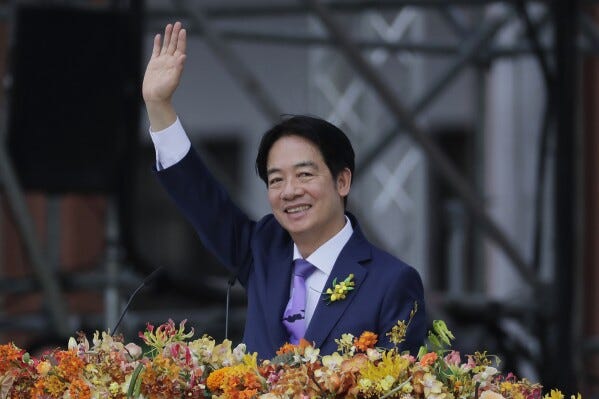
A recent episode involving Taiwan President Lai Ching-te highlights how the contest between Beijing and Taipei is expanding into new domains.
Seychelles, Mauritius, and Madagascar denied overflight access to Lai’s aircraft, forcing him to cancel a planned visit to Eswatini. China welcomed the move as support for the One China principle. Taiwan, in contrast, described it as political coercion.
On the surface, this looks procedural. In reality, it signals a shift. Taiwan’s leaders have long managed international travel even without formal diplomatic recognition from transit countries. Blocking airspace access moves beyond symbolic isolation and into direct operational constraint.
The destination itself matters.
Eswatini is a small, landlocked country in southern Africa, bordered by South Africa and Mozambique. It is also the last African state that maintains official diplomatic ties with Taiwan. Over the past few decades, nearly every other country on the continent has switched recognition to Beijing, largely driven by economic incentives and political alignment.
For Taiwan, relationships like the one with Eswatini are not just ceremonial. They are central to maintaining formal international space. Presidential visits serve to reinforce these ties through development aid, political engagement, and visibility on the global stage.
Lai’s trip was meant to do exactly that. Strengthen one of Taiwan’s remaining partnerships and signal continued diplomatic relevance.
The disruption of that visit points to something broader. China is not only limiting Taiwan’s recognition but also increasingly shaping the conditions under which it can operate internationally. Its influence now reaches into decisions made by countries geographically distant from the Taiwan Strait, affecting even the logistics of travel.
What stands out is the compliance of states with limited direct stakes in cross-strait tensions. Their decisions suggest that alignment with Beijing is often driven less by ideology and more by material considerations and long-term strategic positioning.
In that sense, this was not just a canceled trip. It was a demonstration of how pressure on Taiwan is becoming more practical, more global, and harder to bypass.
Thank you for reading!