

Hello Readers,
Thank you for continuing to support the newsletter. I have been busy with some personal life stuff, which kept me away from writing the newsletter.
By the way, the Terton Watch is curated news feed for major developments from China and rest of East Asia. Please check it out for your daily dose: tertonintel.com/watch
Now, the newsletter continues.
U.S.-China boards and short truce extension set stage for Shenzhen APEC
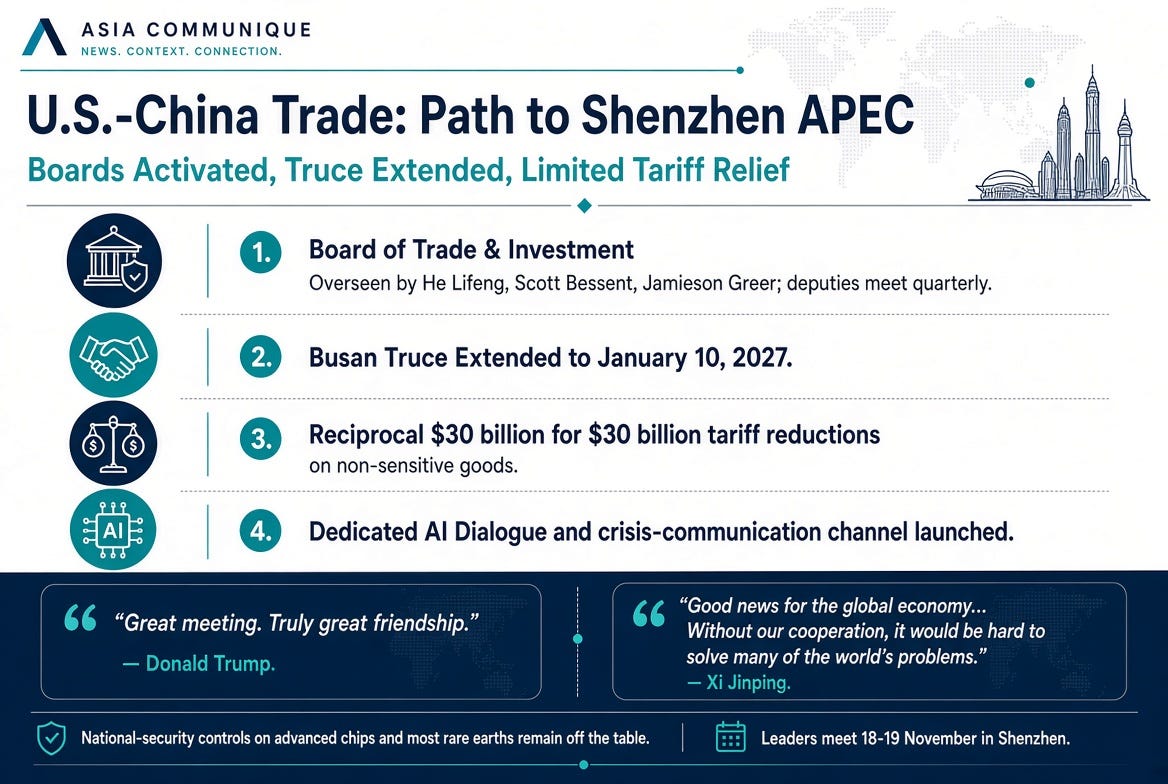
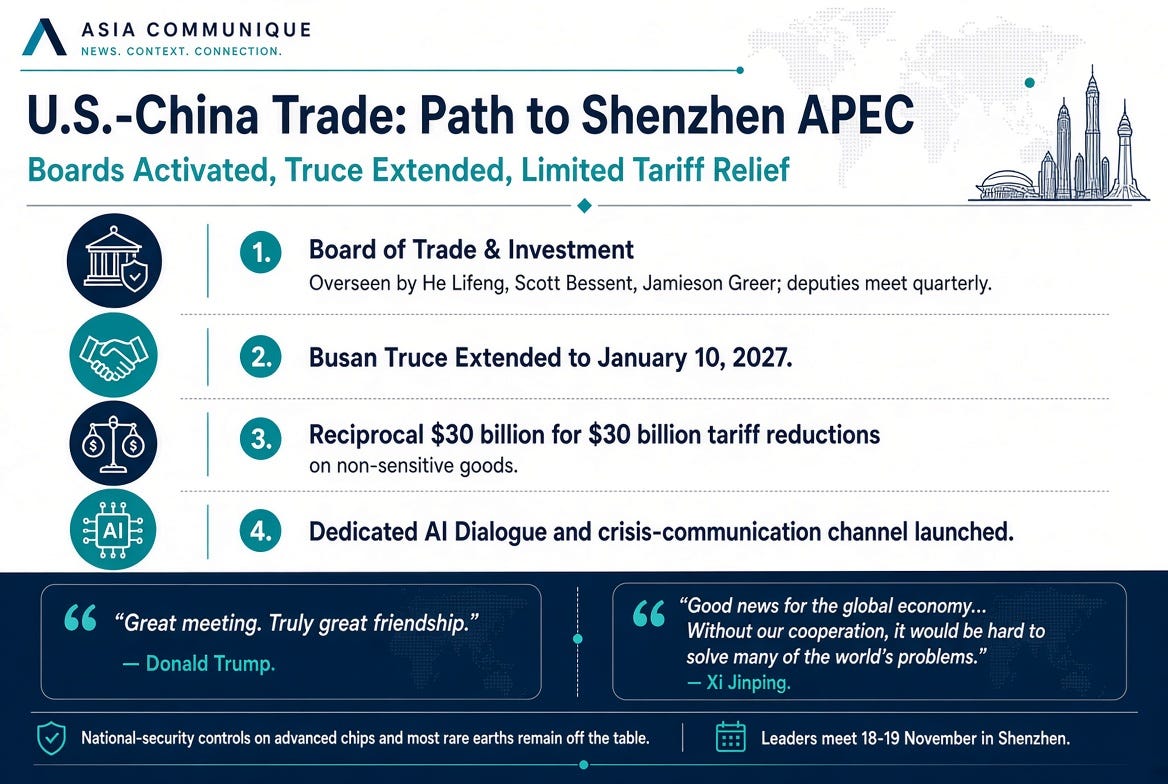
Negotiators are under pressure to convert the limited economic outcomes from the September Washington summit into concrete packages before Xi Jinping and Donald Trump meet again next month in Shenzhen. Both sides continue to keep national-security controls firmly outside the scope of these talks.
The September 24-26 summit in Washington operationalized the U.S.-China Board of Trade and Board of Investment, mechanisms that had been agreed in principle during the May meeting in Beijing. The Board of Trade, overseen on the Chinese side by Vice Premier He Lifeng and on the U.S. side by Treasury Secretary Scott Bessent and Trade Representative Jamieson Greer, is tasked with managing a reciprocal framework that would lower tariffs on roughly $30 billion of non-sensitive goods in each direction. It also includes an agriculture working group. Deputies are expected to meet at least quarterly.
The summit extended the Busan trade truce, originally set to expire on November 10, by two months through January 10, 2027. It also launched a dedicated AI dialogue and a bilateral channel for AI-related incidents, with further talks expected before the end of November. China committed to import at least 10 million metric tons of U.S. coal in both 2027 and 2028, while the U.S. secured selective purchase and market-access commitments.
The goods covered under the tariff framework include U.S. agricultural products, seafood, wood products, cosmetics, and medical devices on one side, and Chinese consumer items such as small appliances, toys, holiday decorations, and children’s car seats on the other. More than 90 percent of the affected products are expected to return to WTO-bound rates. Suspensions of certain Chinese rare-earth licensing requirements and of the U.S. Bureau of Industry and Security Affiliates Rule were extended in principle, but formal implementing notices have lagged and some uncertainty remains about their full legal effect. National-security controls on advanced semiconductors, which Greer has described as the crown jewels of U.S. technology, along with broader critical-minerals licensing, entity lists, and most dual-use regimes, were left explicitly outside the discussions.
Working-level talks continue on investment frameworks and the first deliverables from the new boards. Sources describe progress since the May and September meetings, yet significant hurdles remain around institutional design, leverage, and verification of Chinese commitments. The Board of Investment has so far received less operational detail than the Board of Trade. Some U.S. executives have shown limited enthusiasm for the Shenzhen events, citing uncertainty over schedules and content. Trump has indicated openness to a trilateral nuclear discussion involving Xi and Putin, although no agenda has been set. APEC finance ministers meeting in Hong Kong this week highlighted persistent global imbalances and the need for better coordination on artificial intelligence, the digital economy, and green growth. The APEC leaders’ meeting is scheduled for November 18-19 in Shenzhen, with the CEO Summit on November 17-18.
Chinese readouts of the Washington summit have been thinner on coal purchases and the Board of Investment than U.S. statements. Advanced chip controls, broader rare-earth restrictions beyond the limited suspended measures, military issues, and Taiwan remain outside the current economic track.
The new boards create a standing channel that could reduce the risk of pure tariff escalation on non-sensitive goods. Yet the short two-month truce, incomplete implementation of the suspensions, and the exclusion of strategic technology mean the relationship continues to operate through temporary reprieves rather than structural resolution. The Shenzhen meeting will test whether these mechanisms can produce visible, verifiable deals or whether they will primarily serve to manage friction ahead of further encounters, including the G20 in Miami.
Meanwhile, Trump says he is open to trilateral summit with Putin and Xi but he want denuclearization on the table.
Japan months from yttrium crunch as China tightens rare-earth chokehold
Tokyo has asked Washington to press Beijing to ease export controls on yttrium after Japanese stockpiles of the critical metal dwindled to months of supply. Global exports have stalled and prices have soared, threatening auto, jet-engine, and semiconductor production and exposing the limits of the recent U.S.-China rare-earth truce.
Japanese government officials and trading-house executives told the Financial Times that domestic supplies of yttrium—a heat-resistant rare earth essential for coating engines, plasma-etching chambers used in chip manufacturing, consumer electronics, LEDs, and other industrial applications—could run critically low by the end of this year. An anonymous industry ministry official confirmed on Wednesday that “exports of yttrium have stalled not only to Japan but worldwide, causing a supply-demand crunch and soaring prices,” with shipments to Japan down including delays and overall global volumes low. Tokyo has asked the U.S. government and American companies to lobby Beijing to increase flows. The squeeze follows Beijing’s tightened controls on Japan after Prime Minister Sanae Takaichi’s comments last November suggesting Japan could intervene militarily in a Taiwan contingency. She later described yttrium in July as “globally scarce” and “an important rare earth for our country.”
Chinese customs data show yttrium oxide exports to Japan fell to 4,000 kilograms in September, compared with 51,000 kilograms in the same period a year earlier. Prices outside China have surged to $1,150 per kilogram—a 179-fold increase versus two years ago—versus roughly $9 per kilogram inside China, according to Argus. China accounts for almost two-thirds of rare-earth mining production and 92 percent of global refined output, according to the International Energy Agency. U.S. defense supply chains rely on Japanese components containing the metal. A senior U.S. official said China is fulfilling roughly two-thirds of its rare-earth commitments to the United States under the existing trade truce but is allowing Japan only the bare minimum. Washington has linked the issue to jet engines for China’s Comac C919 and to complications around a previously discussed Boeing order.
U.S. and Japanese officials have held multiple talks, including a critical-minerals “rapid response group” meeting in Washington last month involving the U.S. Energy Department and Japan’s industry ministry. That session took place two weeks before the Trump-Xi White House summit. Tokyo is also coordinating with the United States and European nations on critical minerals and rare earths, including yttrium. The U.S. has repeatedly pressed China to fulfill its pledge, reiterated after the May Beijing meeting, to address supply-chain shortages for rare earths including yttrium. Chinese foreign ministry spokeswoman Mao Ning stated that controls on Japan were imposed “in accordance with laws and regulations, with the aim of curbing Japan’s attempts at remilitarization and possessing nuclear weapons.” Japan’s current defense plans do not include nuclear weapons. Japanese officials warn that “rare earth saving efforts have a limit” and that failure to act now creates “systemic risk to the world economy.”
Broader Chinese rare-earth licensing remains largely intact beyond the limited suspensions tied to the Busan-linked truce. Diversification efforts in the United States, Australia, and other non-Chinese mining and processing projects are advancing but are not yet scaled to offset near-term Japanese or allied shortfalls in heavy rare earths.
The yttrium crunch shows that the September Washington summit and truce extension have not neutralized Beijing’s critical-minerals leverage, particularly against U.S. allies that take firm positions on Taiwan. The sharp September drop in shipments and the official confirmation of a global stall reinforce the urgency of building non-Chinese processing capacity. They also give both Washington and Tokyo a concrete test of whether the new Boards of Trade and Investment can produce real supply relief before the Shenzhen APEC meeting.
China allows Philippine resupply at Second Thomas Shoal while shadowing U.S. ship and clashing with Taiwan at Pratas
China’s coast guard said it permitted and closely supervised a Philippine resupply mission to the grounded warship BRP Sierra Madre at Second Thomas Shoal on Wednesday, even as Beijing continued to assert control over the feature and tensions remained elevated after Manila summoned China’s ambassador over remarks it viewed as threatening. The same week, Chinese naval forces tracked a U.S. warship near Sabina Shoal and Taiwan’s coast guard reported a standoff with a Chinese vessel near the Pratas Islands.
The China Coast Guard stated that the Philippines delivered necessities to the BRP Sierra Madre with permission from the Chinese side. Spokesman Jiang Lue said Chinese vessels conducted confirmation checks and maintained full supervision throughout the operation, adding that China would continue rights-protection and law-enforcement activities in the area. Beijing described the Philippine vessel as illegally grounded. The mission came roughly a month after the Philippine Coast Guard accused Chinese ships of obstructing an earlier resupply run on September 25, when Manila said dangerous maneuvers by the China Coast Guard and PLA Navy created a risk of collision and forced a temporary suspension. In a separate September incident, a China Coast Guard vessel rammed a Philippine boat on a refueling mission near another shoal; China blamed the Philippines.
Diplomatic friction has also risen. On October 19 the Philippine foreign ministry summoned China’s ambassador to express serious concern and strong objection over remarks by the envoy that Manila said conveyed a threat of the use of force. The Chinese diplomat rejected that characterization. Second Thomas Shoal (Ayungin to the Philippines, Renai Jiao to China) remains one of the most consistent flashpoints because the Philippines has maintained a small garrison aboard the rusting Sierra Madre since deliberately grounding it in 1999 to reinforce its claim.
Separately, China’s Southern Theatre Command said it dispatched naval forces to track and monitor the U.S. Navy littoral combat ship USS Charleston after the vessel illegally intruded into waters adjacent to Sabina Shoal in the Spratly Islands without Chinese approval. The command described the action as infringing on China’s sovereign rights, jeopardizing maritime security, and harming regional peace and stability, and called on the United States to cease such activities. A Philippine military spokesperson responded that the U.S. ship had not trespassed into Chinese territory and that no nation has the authority to require prior permission for lawful transit through international waters. The United States and the Philippines share a mutual defense treaty; both countries, along with China, contest Sabina Shoal and the broader Spratly chain.
Further north, Taiwan’s Coast Guard reported that a Chinese Coast Guard ship entered restricted waters near the Taiwan-controlled Pratas Islands. Taiwan dispatched the cutter Taichung to issue warnings. The Chinese vessel broadcast that the so-called Republic of China does not exist, while the Taiwanese ship replied that the Republic of China, Taiwan, is a sovereign and independent country. The standoff continued for a period. Taiwan’s Coast Guard is responsible for the lightly defended Pratas Islands, which lie between southern Taiwan and Hong Kong. China has increased coast-guard activity around Taiwan in recent months, including off the island’s east coast.
These incidents illustrate the persistent gap between the relatively stable tone of recent U.S.-China economic talks and the ongoing operational friction in the South China Sea. China continues to treat Philippine presence at Second Thomas Shoal and U.S. freedom-of-navigation passages as subject to its approval, while Manila, Taipei, and Washington reject that premise. The pattern of close supervision, occasional obstruction, and parallel activity near Taiwan’s outlying islands keeps the risk of miscalculation elevated even when individual resupply missions proceed without collision.
Taipei mayoral race tightens amid Chinese disinformation surge
Taiwan’s National Security Bureau reported that China disseminated more than 2.5 million pieces of disputed or false online information targeting the island in the first nine months of 2026, a 48 percent rise from the prior year, with the content focused on energy, food security, defense policy, and specific candidates ahead of the November 28 local elections. The bureau said Beijing has expanded AI-driven operations to shape voter preferences. Mainland Affairs Council Minister Chiu Chui-cheng separately described the activity as brazen election interference through cognitive warfare.
In Taipei, a recent poll showed DPP candidate Puma Shen leading KMT Mayor Chiang Wan-an 50.3 percent to 33.3 percent, reversing a narrow Chiang edge from September. Shen has campaigned mainly on local livability issues, while Chiang has stressed his first-term record. Although local races have historically turned on municipal performance rather than cross-strait policy, the competitive capital contest and the documented information operations give the results an international dimension that both Taipei and foreign observers are tracking.
Taiwan’s economic espionage problem
Taiwan has pursued a series of semiconductor-related economic espionage and export-control cases this year, reflecting sustained efforts to limit the flow of restricted chips and trade secrets to China.
In early October, the New Taipei District Prosecutors’ Office indicted 10 individuals for allegedly using forged documents and false ties to the National Chung-Shan Institute of Science and Technology to obtain controlled U.S. chips from Analog Devices and Texas Instruments, then reselling them via Hong Kong to Chinese entities. Prosecutors said the scheme generated more than NT$300 million in illicit profits and that the chips could support military applications such as radar and electronic warfare. Sentences sought range up to 10 years.
Focus Taiwan: https://focustaiwan.tw/society/202610060020
Taipei Times: https://www.taipeitimes.com/News/front/archives/2026/10/07/2003865523
Straits Times: https://www.straitstimes.com/asia/east-asia/taiwan-indicts-10-for-alleged-resale-of-us-chips-to-china
Other recent cases include the July indictment of a former TSMC deputy manager accused of copying core technologies with intent to transfer them to a China-based materials analysis firm, and earlier convictions tied to the theft of TSMC process secrets involving a Tokyo Electron unit. Separately, Taiwan has moved to strengthen controls on AI servers and advanced chips under the Foreign Trade Act after earlier smuggling cases involving Nvidia-related hardware.
Taiwan News (ex-TSMC manager): https://www.taiwannews.com.tw/news/6404754
Reuters (Tokyo Electron case): https://www.reuters.com/legal/litigation/taiwan-court-hands-out-jail-terms-up-10-years-tsmc-trade-secrets-case-2026-04-27/
These cases illustrate the dual track of trade-secret theft from Taiwan’s leading foundries and the diversion of controlled Western chips through local intermediaries, both of which Taipei treats as national-security risks.
Further readings
The Case for Economic Espionage — Foreign Affairs
Major Japan-US joint military drills kick off to boost regional defense — The Manichi