

Background: An enduring partnership
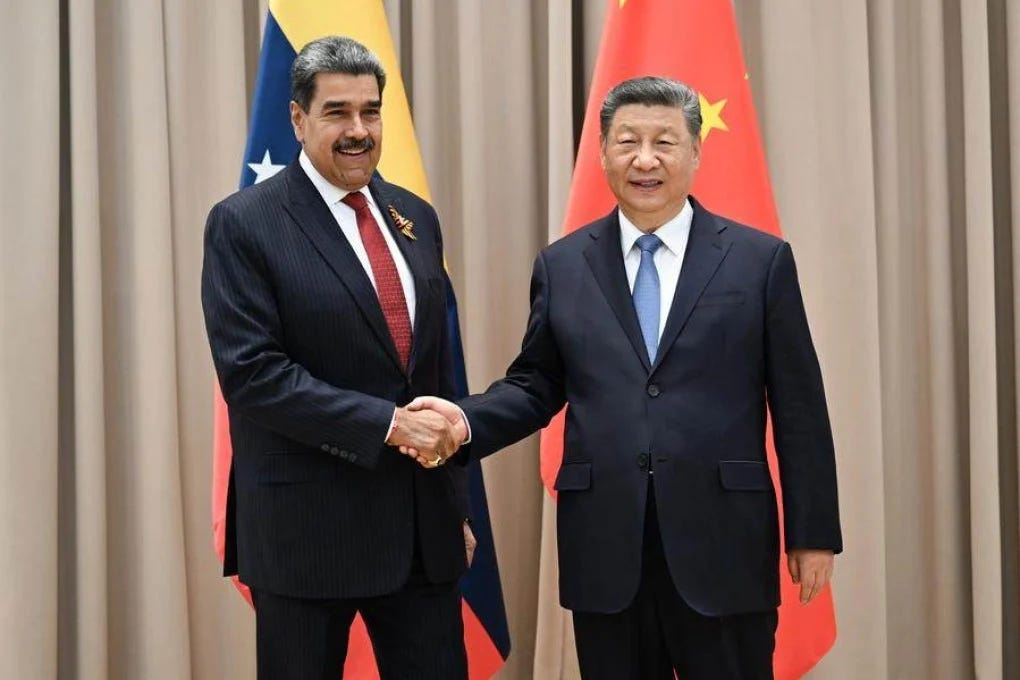
China has built a deep political and economic relationship with Venezuela over the past two decades. During the 2024 Venezuelan presidential election, the Chinese foreign ministry publicly congratulated President Nicolás Maduro on his re‑election and stressed that Beijing would continue to “deepen the all‑weather comprehensive strategic partnership.” Chinese state media framed the vote as proof that Venezuelans wanted stability rather than regime change and predicted the United States would have difficulty rallying opposition to Maduro. In June 2024 Foreign Minister Wang Yi hosted Venezuelan foreign minister Yván Gil in Beijing and emphasized that the two countries would “jointly oppose external interference and bullying,” deepen cooperation in energy, technology and finance, and defend Global South solidarity.
Rising tensions in 2025: naval build‑ups, seizures and the Monroe Doctrine
Sept 2025: U.S. naval presence prompts alarm
China’s official news agency Xinhua reported that Venezuelan President Maduro labelled the U.S. naval deployment near Venezuelan waters as the country’s “biggest threat in 100 years.” He dismissed U.S. allegations of drug trafficking and described Washington’s actions as unjustified. Chinese commentators echoed this narrative. On 15 September the foreign ministry’s spokesperson Lin Jian warned that U.S. seizures of a Venezuelan fishing boat and military deployments near Venezuelan waters “threaten regional peace and security” and violate international law. When the U.S. launched a second strike on a Venezuelan vessel the following day, Lin denounced the action as unilateral and urged Washington to respect Venezuela’s sovereignty and the Caribbean’s designation as a “zone of peace”.
November–December 2025: Operation Southern Spear and airspace tensions
As the U.S. announced Operation Southern Spear—an operation targeting the Venezuelan military and a U.S. designation of the Cartel de los Soles as a terrorist group—foreign ministry spokeswoman Mao Ning said China opposed “external forces interfering in Venezuela’s internal affairs under any pretext.” She called on Washington to stop unilateral actions, respect the sovereignty of Latin American states and honor the 2014 proclamation declaring the region a zone of peace. In early December, when U.S. officials suggested closing Venezuelan airspace to commercial flights, spokesman Lin Jian criticized the proposal as a colonialist threat reminiscent of the Monroe Doctrine. He argued that Washington’s rhetoric about “protection of the hemisphere” showed the United States still considered Latin America its backyard.
UN Security Council confrontation
On 24 December a U.N. Security Council meeting was convened after U.S. forces seized Venezuelan oil tankers. Chinese envoy Sun Lei accused Washington of violating international law and Venezuelan sovereignty, arguing that the U.S. justification of protecting hemispheric security was a revival of the Monroe Doctrine. An expert quoted by the Global Times said the seizure of oil tankers and talk of hemisphere protection were attempts to legitimize American hegemony.
January 2026: U.S. strikes and the capture of Maduro
Operation against Maduro
On 3 January 2026 U.S. forces conducted air strikes on Venezuelan sites and announced the capture of President Maduro. Chinese state media reacted with alarm. The foreign ministry said China was “deeply shocked” and “strongly condemns” the U.S. use of force, describing it as a hegemonic act that seriously violated international law and Venezuela’s sovereignty. In a formal statement, the ministry demanded that Washington abide by the U.N. Charter and stop interfering in other countries’ internal affairs. The Global Times repeatedly carried this condemnation and warned that the attack would destabilize the region and undermine the international order. Chinese officials also advised citizens to avoid travel to Venezuela due to “rising security risks”.
Chinese military analysts interviewed by state media argued that the U.S. strikes were unlawful and reflected Washington’s willingness to use force to achieve political ends. They highlighted that the operation revived the Monroe Doctrine and was driven partly by U.S. interest in Venezuelan oil. The analysts added that despite deploying elite Delta Force units, Washington had violated international norms and destabilized Latin America. State media also noted that some U.S. lawmakers criticized the operation for bypassing Congress and breaching international law.
Commentary emphasizing international law
Chinese newspapers framed the strikes as a stark example of who truly undermines international law. A People’s Daily commentary argued that the U.S. attack violated Article 2(4) of the U.N. Charter, which prohibits the threat or use of force against another state’s territorial integrity or political independence. It characterized the Monroe Doctrine as an outdated concept and urged the international community to oppose unilateralism and defend the sovereignty of all nations. Xinhua’s roundup of global reactions similarly quoted Chinese officials calling the strikes hegemonic and urging the U.S. to respect the U.N. Charter.
Analysis: subtext in China’s messaging
Chinese state media coverage of the Venezuelan crisis reveals several themes:
Defense of sovereignty and the U.N. Charter. Beijing consistently framed U.S. actions—from naval deployments to the January 2026 strikes—as violations of international law and Venezuelan sovereignty. The foreign ministry repeatedly invoked the U.N. Charter to legitimize its stance.
Critique of U.S. hegemony and revival of the Monroe Doctrine. Commentaries described U.S. rhetoric about “protecting the hemisphere” as a re‑packaging of the Monroe Doctrine—a symbol of colonialism. China’s narrative warns that Washington seeks to turn Latin America into its backyard, especially through control of oil resources.
Solidarity with the Global South. By congratulating Maduro and strengthening ties with Caracas, Beijing signals support for left‑leaning governments in the region. Chinese officials emphasize mutual respect and non‑interference, aligning with the rhetoric of a “zone of peace” in Latin America.
Warning to Chinese citizens. Alongside political commentary, the foreign ministry issued travel warnings and advised Chinese nationals to avoid Venezuela amid uncertainty. This shows that Beijing is preparing for potential crises while publicly supporting Caracas.
What to watch next
International response to Maduro’s detention. Beijing will likely use multilateral forums to criticize U.S. unilateralism and support Venezuela’s call for Maduro’s release. The outcome may shape China’s engagement with regional organizations such as CELAC and the U.N. Human Rights Council.
Energy and economic ties. Venezuela’s oil reserves are strategic. If Washington tightens sanctions, Beijing might increase financial and technical support to ensure access to crude oil, deepening the partnership forged in 2024.
Implications for the Global South. The crisis is a test of China’s positioning as a champion of sovereignty and South–South cooperation. How Beijing navigates the crisis—balancing its principles against pragmatic interests—will send a signal to other Latin American states wary of U.S. intervention.
In short: China can’t do much immediately but it will look for a different recourse in another theatre in the future. Commentators online are drawing a parallel to Taiwan by saying that Trump and Xi have a tacit agreement to carve up the world — that’s far from true.
Washington just approved an $11 billion weapons sale to Taiwan and there are no signs that Trump is about to abandon Taiwan. On the contrary, Xi might be drawing a lesson that China may need to weaken Taiwan internally before using military force — just as Trump did in Venezuela. This is part of a plan Beijing has held for sometime now and there remain many challenges in trying to accomplish such a move. Taiwan is no Venezuela. Taipei is armed with U.S. weaponry and has a strong U.S. support in its immediate neighborhood.
Therefore, Beijing isn’t going to move on Taiwan just because of events in Venezuela.