

Hello all,
Overview
Over the last 24 hours, Asia witnessed significant developments across defense, security and economic fronts. These stories reveal how geopolitics, trade policies and domestic issues are shaping the region’s trajectory. Highlights include Vietnam’s ambitious growth pledge, Taiwan’s push to build a “democratic” high-tech supply chain with the U.S., South Korea’s sluggish economic performance, Japan’s early election and its implications for monetary policy, and incidents affecting security from Afghanistan to Pakistan and Australia.
Economic & Market Developments
Vietnam sets an aggressive growth target
Growth pledges – At the Communist Party Congress in Hanoi, Vietnam’s General Secretary To Lam committed to achieving annual economic growth of above 10% until 2030. Lam argued that cutting red tape, investing in infrastructure to cope with climate change, expanding global trade and combating corruption would be critical. The government recorded a record trade surplus with the U.S., helped by tariffs on Vietnamese exports.
Taiwan–U.S. supply-chain deal and tariffs
Tariff reduction – Taiwan’s Vice Premier Cheng Li-chiun announced that under a new deal with Washington, general U.S. tariffs on Taiwanese exports will be cut from 20% to 15%; lower tariffs will apply to chipmakers that invest in U.S. production facilities. Taipei will invest US $250 billion in American semiconductor, AI and clean-energy projects and provide another US $250 billion in credit. The deal aims to build a “democratic” high-tech supply chain. Cheng stressed that Taiwan is extending rather than relocating its supply chain. Now, this is a political decision as much as it’s a trade decision. There is already an undercurrent of domestic tension over the decision, and we will need to see how people in Taiwan react to this reshoring of the chains.
China’s Population Decline Accelerates in 2025
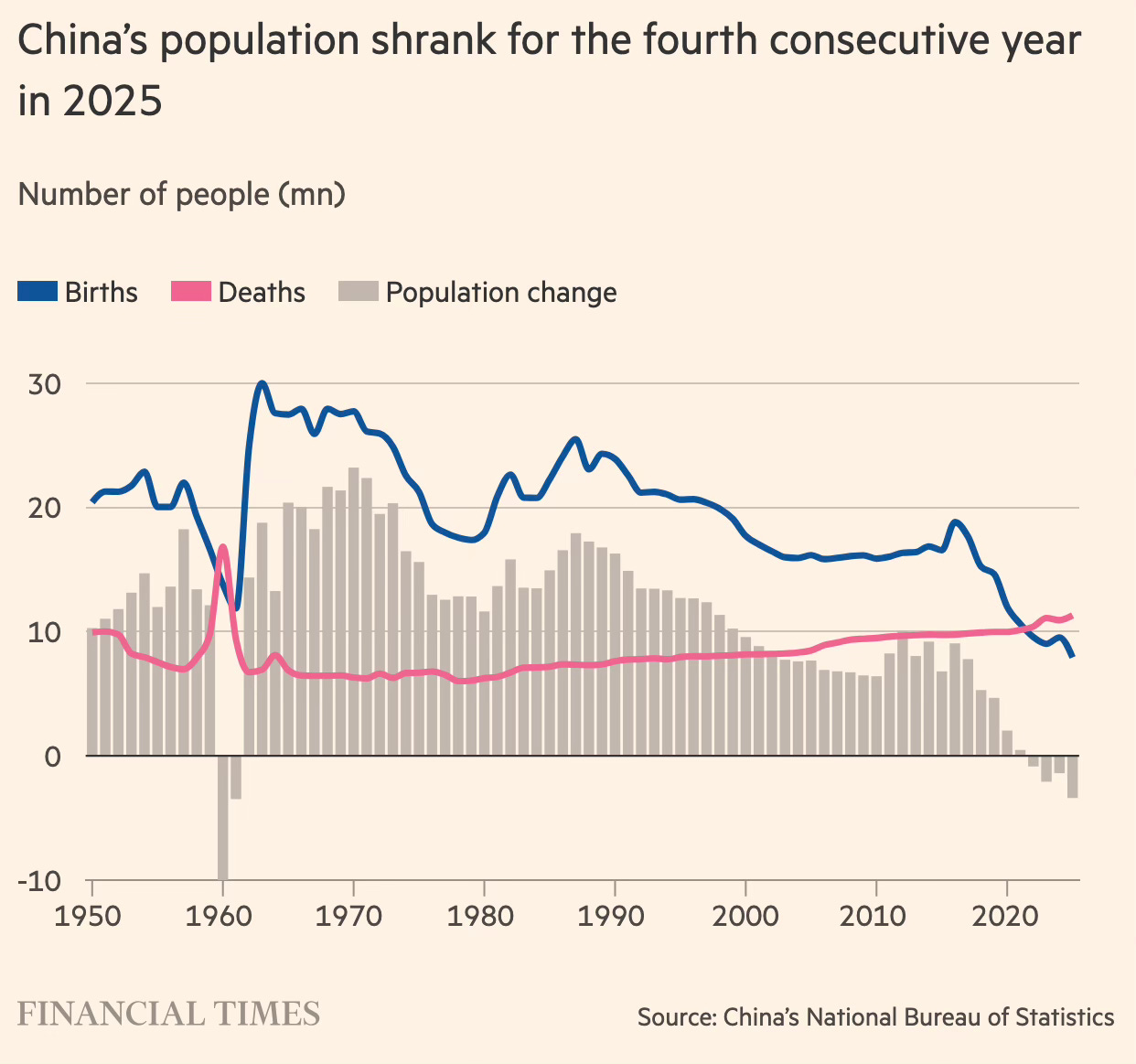
China’s population fell for a fourth consecutive year in 2025, with births dropping to a record low of 7.92 million — down 17% from 2024 — according to official data. The total population shrank by 3.39 million to 1.405 billion, while deaths rose to their highest level since 1968, highlighting the scale of the country’s demographic crisis.
The decline comes despite new government incentives, including a 90 billion yuan childcare subsidy program and expanded coverage for childbirth and IVF. High living costs, weak job prospects, and urban childcare expenses continue to discourage young people from starting families. The average cost of raising a child to age 18 now exceeds six times China’s GDP per capita.
With fertility at around one birth per woman and nearly a quarter of the population aged over 60, Beijing faces growing pressure on labor supply, pension systems, and long-term economic growth — making demographics an increasingly central policy challenge.
South Korea’s economy barely grows
Weak Q4 growth – A Reuters poll showed that South Korea’s economy probably expanded by just 0.1% quarter-on-quarter in Q4 2025 (vs 1.3% in Q3) and by 1.9% year-on-year. Economists attributed the slowdown to weak domestic demand, particularly in construction investment and discretionary consumption. Exports remained a bright spot: official trade data showed exports rose 13.4% in December despite a 15% U.S. tariff on all South Korean goods. Economists noted that government cash-handout programs boosted consumption in Q3 but their effect faded in Q4.
Policy implications – The poll suggested the Bank of Korea is likely to hold rates after signaling the end of its easing cycle and maintain a cautious stance because the won remains weak. Economists said further rate cuts are unlikely given currency weakness and high house prices.
Japan’s fiscal-monetary cross-currents
Snap election – Prime Minister Sanae Takaichi will dissolve parliament and call a 8 February national election to seek voter approval for increased spending, tax cuts and a new security strategy that will accelerate defense spending. She promised a two-year halt to the 8% consumption tax on food, a move that government officials say would cost about ¥5 trillion (US $32 billion) in revenue and has already pushed 10-year Japanese government bond yields to a 27-year high. The snap election is intended to strengthen her grip on the ruling Liberal Democratic Party ahead of an anticipated defense build-up.
BOJ outlook – The Bank of Japan is expected to keep its policy rate at 0.75% at its meeting on 23 January but may raise its growth forecast and signal that more rate hikes are likely. Analysts note that yen depreciation and Takaichi’s tax-cut plans complicate the central bank’s decisions. The BOJ has already raised rates to a 30-year high but may consider further hikes as the yen slides and inflation broadens. Some policymakers even see room for an April rate increase.
Commodity & currency markets
Oil prices buoyed by China and tariffs – Oil prices rose as China’s economy grew 5.0% in 2025, exceeding expectations and supporting demand optimism. Brent crude climbed 0.3% to US $64.13 per barrel, and the U.S. West Texas Intermediate contract added 0.4% to US $59.69. Analysts said the data reinforced China’s resilience in exports and refinery output. Markets also watched U.S. President Donald Trump’s threat to impose additional tariffs on European nations to force a deal for buying Greenland; the threats weakened the U.S. dollar and lent further support to oil prices.
Indian rupee pressure – Traders warned that the Indian rupee remains vulnerable near ₹91 per U.S. dollar; the Reserve Bank of India has been selling dollars intermittently but not defending a specific level. The currency is susceptible to further declines given sustained dollar demand and global trade uncertainties.
BHP’s production and price concessions – Mining giant BHP Group reported a record first-half iron-ore output (146.6 million tonnes), but accepted lower prices in negotiations with Chinese buyers and flagged a 20% cost increase at its Jansen potash project. Chinese steel mills have been told to avoid certain BHP ores, potentially tightening spot-market supply.
Defense & Security Developments
Japan: Election to bolster defense build-up
Prime Minister Sanae Takaichi’s snap election has a clear security rationale. She intends to implement a new national security strategy that will raise defense spending to 2% of GDP, breaking Japan’s long-standing cap of around 1%. Takaichi said China’s military exercises around Taiwan and “economic coercion” through control of key supply-chain materials make the international security environment more severe. The early vote is designed to capitalize on her popularity and push forward the defense build-up.
Korean Peninsula: Drone incident stokes tensions
South Korean President Lee Jae Myung revealed that a civilian drone had flown from South Korea into North Korea, exposing a loophole in the monitoring system. Lee called the incident “akin to starting a war” and warned that such provocations could harm the economy and tensions on the peninsula. He ordered a thorough investigation; if a South Korean citizen deliberately flew the drone, they could face criminal charges. North Korean leader Kim Jong Un’s sister, Kim Yo Jong, urged Seoul to investigate the incident and hinted at serious consequences.
Afghanistan: Islamic State targets Chinese-run restaurant
A suicide bomber attacked a Chinese-run restaurant inside a hotel in Kabul’s Shahr-e-Naw district, killing one Chinese national and six Afghans and injuring several others. The Islamic State group claimed responsibility, stating it targeted Chinese citizens over alleged abuses of Uyghurs. The blast underscores the persistent security risks facing foreign businesses and China’s increasing exposure in Afghanistan.
Pakistan: Deadly mall fire
A massive fire at the Gul Plaza shopping mall in Karachi killed at least 21 people and left more than 60 missing. The blaze burned for more than 24 hours, causing portions of the building to collapse, hampering rescue efforts and sparking public anger over perceived delays. Authorities promised an inquiry; many survivors lost businesses and loved ones.
Australia: New gun laws and shark-attack closures
Gun reforms – In the wake of the December Bondi mass shooting (15 fatalities), Australia’s lower house passed comprehensive gun-control legislation that will create a national gun buyback program and tighten background checks. The reforms limit the number of firearms per individual and require more frequent license renewals. Prime Minister Anthony Albanese’s government expects the Senate to approve the legislation soon, despite conservative opposition.
Beach safety – Authorities closed dozens of beaches along Australia’s east coast, including in Sydney, after four shark attacks in two days. Heavy rain left waters murky, attracting bull sharks, and several surfers—some critically injured—required hospitalization. Surf Life Saving New South Wales urged swimmers to use pools until conditions improve.
Other regional dynamics
Japan–Philippines security pacts – Though signed five days earlier, the effects of the new Acquisition and Cross-Servicing Agreement between Japan and the Philippines continue to reverberate. The pact allows their militaries to exchange supplies and services and reflects increasing strategic cooperation amid rising tensions in the Taiwan Strait. Japan also pledged US $6 million to build facilities for inflatable boats it donated to boost the Philippine naval capacity.