

Chokepoint Wars: How Iran and China Are Turning Trump’s Aggression Against Him
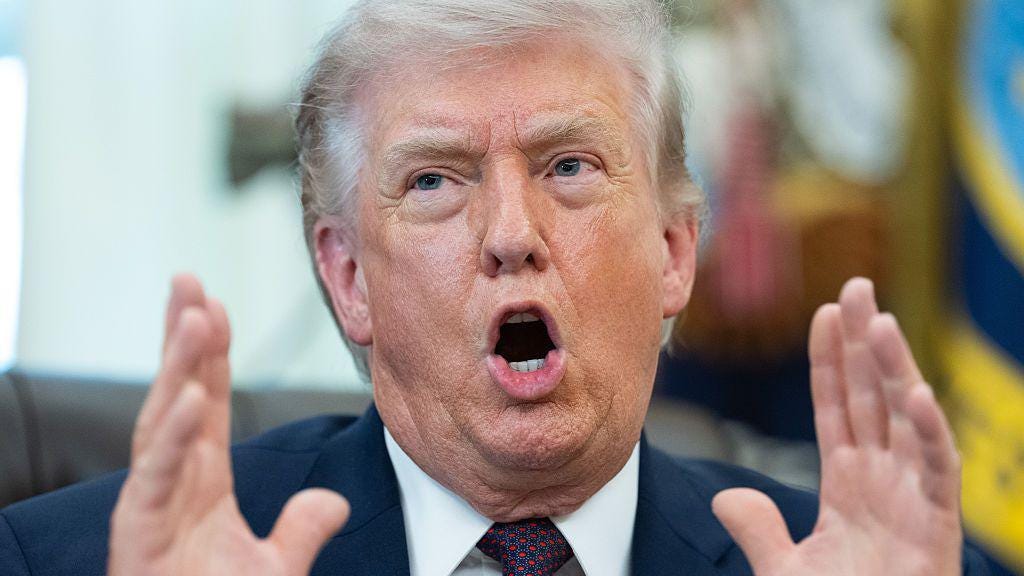
One year after President Trump unveiled his “Liberation Day” tariffs from the Rose Garden, a new and uncomfortable reality is crystallizing for Washington. The world has been taking notes — and taking action. From the Persian Gulf to rare-earth processing plants in China, rival nations are no longer simply absorbing American economic pressure. They are redirecting it.
The Strait That’s Shaking the Global Economy
The Strait of Hormuz is a narrow waterway, but the numbers it carries are enormous. About 20% of the world’s oil and gas passes through it daily. Since late February, when the United States and Israel began military operations against Iran, it has been effectively closed.
The economic fallout has been swift. Analysts at Evercore ISI downgraded U.S. GDP growth projections for 2026 from 2.8% to 2.2%, with a corresponding uptick in core inflation. Fuel surcharges are trickling into food distribution. Shipping rates for imported goods have jumped sharply. And with midterm elections on the horizon, the political pain is intensifying alongside the economic pressure.
In a Wednesday night address, Trump framed the situation coolly, noting that the United States receives “almost no oil” through the strait and suggesting that other dependent nations should lead efforts to protect it. Markets disagreed with his calm: oil prices surged and stocks fell the next morning.
The deeper point here is hard to ignore. Iran accounts for less than 1% of global economic output. Yet its geographic position gives it leverage wildly disproportionate to its size. This is precisely the kind of asymmetric power that Trump’s own playbook was supposed to exploit — and now it is being used against him.
China’s Quiet, Methodical Squeeze
Beijing has been playing an even longer game. China controls the processing of the vast majority of the world’s rare-earth minerals, the materials that go into semiconductors, fighter jets, MRI machines, electric vehicles and AI data centers. Since Liberation Day last April, it has been systematically building out a licensing regime for rare-earth exports, quietly cutting off companies in the U.S. defense supply chain while placing others under case-by-case review.
The effects are becoming visible. Medtronic CEO Geoff Martha acknowledged this week that China’s controls are hitting manufacturers of MRI and CT imaging machines. Defense contractors are scrambling for alternative sourcing with limited success. Former Commerce Secretary Gina Raimondo, who says she saw all of this coming, warned at a Council on Foreign Relations event that the AI data center supply chain carries a similarly alarming level of Chinese dependency that most Americans have not yet reckoned with.
Trump’s decision to delay a planned visit to China until mid-May added to the anxiety among executives who had been hoping a summit with Xi Jinping could unlock licenses and ease the squeeze.
The Playbook Is Spreading
Edward Fishman, author of Chokepoints: American Power in the Age of Economic Warfare, frames the moment clearly. “The lesson is that the way to deal with American economic coercion is to fight back,” he said. “Iran now is proving that again.” European officials, rattled by Trump’s January rhetoric about seizing Greenland, have also been quietly mapping potential leverage points in U.S. trade relationships. The playbook Iran and China are running is becoming required reading in capitals around the world.
Chokepoints by Fishman looks like a great read that I might pick up soon.
What makes this historically significant is the inversion of America’s own doctrine. The United States built the architecture of economic warfare, from weaponizing the global banking system to choking off semiconductor technology. Rivals with strategic geography or resource dominance are now deploying the same logic back at Washington. Iran holds a waterway. China holds a periodic table. Together, they are demonstrating that even the world’s largest economy has pressure points that cannot be neutralized by tariffs or military force alone.
Trump’s core thesis — that American power, properly leveraged, produces only upside — is being stress-tested in real time. The midterm clock is ticking, and the manufacturing renaissance his tariffs were meant to spark is being quietly hollowed out by the very supply chain dependencies he never fully accounted for.
Taiwan’s Defense Budget Is Frozen. Beijing Could Not Have Written It Better.
The Hormuz closure and China’s rare-earth squeeze share a common thread: smaller or more disciplined actors exploiting structural vulnerabilities in American power. But this week brought a reminder that vulnerability is not always imposed from outside. Sometimes, a country creates its own.
Taiwan is in the middle of doing exactly that.
A Record Budget, Going Nowhere
President Lai Ching-te’s administration put forward a genuinely historic defense budget for 2026 — T$949.5 billion, a 22.9% increase over last year and equivalent to 3.32% of GDP. That figure crosses the 3% threshold for the first time since 2009 and represents a direct response to relentless Chinese military pressure, including large-scale war games simulating a blockade. Washington backed the increase publicly and enthusiastically.
The opposition-controlled legislature has stalled it. Lawmakers say they support higher defense spending in principle but will not sign “blank cheques.” A separate proposal for $40 billion in additional special defense spending is frozen as well. The practical consequence, confirmed Thursday by defense ministry budgeting chief Yen Ming-teh, is that the ministry cannot execute 21% of this year’s budget on the original schedule. That translates to T$78 billion, or about $2.44 billion, sitting idle.
What Cannot Wait
The programs caught in the delay are not abstractions. HIMARS rocket artillery systems, Javelin anti-tank missiles and follow-on pilot training for Lockheed Martin F-16 fighter jets are all affected. These are not legacy procurement items. They are precisely the capabilities Taiwan has identified as essential for a credible defense against a Chinese invasion or blockade scenario.
Yen put it simply at Thursday’s press conference: “Any delay in timing will cause irreversible negative effects.” In procurement terms, that means missed delivery windows, lapsed training cycles, and gaps in readiness that take years to close even after funding is restored.
Taiwan Is Watching, and Learning
There is an striking contrast buried in the same briefing. Even as funding stalls, Taiwan’s military is moving forward intellectually. The island’s annual Han Kuang drills begin April 11, and this year’s table-top exercises will draw directly on two recent conflicts: U.S. and Israeli operations against Iran, and the U.S. military raid that seized Venezuelan President Nicolás Maduro in January.
Joint operations planning chief Tung Chi-hsing said Taiwan is extracting specific lessons: how to execute early warning and immediate response, how to counter drone swarms, how to build and maintain layered air defenses, and how to run anti-infiltration operations. The Iran war in particular — which opened with coordinated strikes designed to degrade air defense and command infrastructure — maps closely onto the scenarios Taiwan has always war-gamed against China.
The one major emerging question from the Iran conflict is whether Taiwan will be able to keep the international waterways open during the conflict. The Middle East conflict has also taught us that Beijing will heavily rely on drones and other autonomous systems during a conflict with Taiwan. This essentially makes it difficult for the shipping lanes to operate as normal.
The Danger in Plain Sight
Taiwan’s predicament captures a tension that democracies navigating great-power competition face everywhere: the machinery of democratic politics can slow the very decisions that security demands be made quickly. Beijing does not operate under that constraint. Its military planning is not subject to opposition budget holds or legislative brinkmanship.
This is not an argument against democratic accountability. But it is a reminder that in the current environment, delay carries real cost. As the Hormuz closure demonstrates, the actors putting pressure on American power have one thing in common: they move with purpose and they move fast. Taiwan’s parliament would do well to notice.
Thanks!