

Hello Readers,
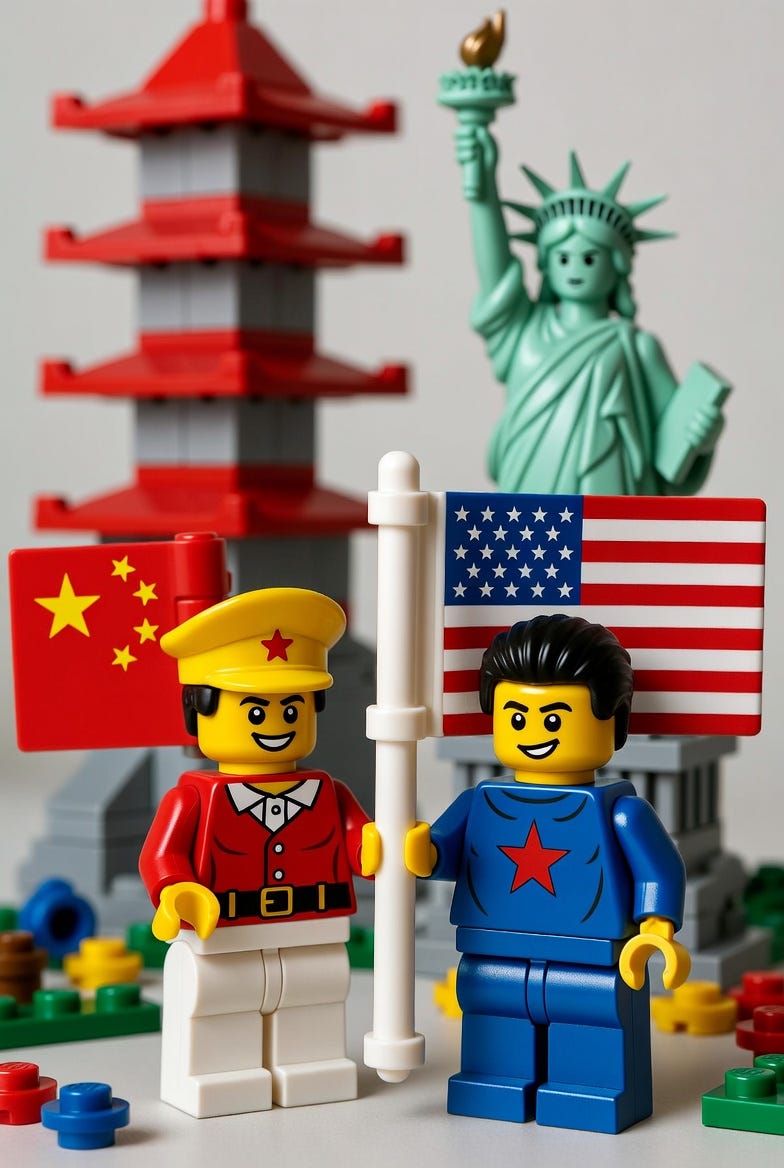
The China OSINT Course has officially started. I’m excited to begin sharing this training with students who want to build practical skills for researching Chinese sources, tracking narratives, investigating companies, and using OSINT methods in a China-focused context.
If you have been considering joining, there is still time to sign up. The course is self-paced, so new students can jump in and start working through the material right away.
Details on how to sign up:
Announcing China OSINT Course for Journalists, Analysts, and Policy Professionals
I’m excited to share that I’m opening enrollment for a new course on China-focused OSINT for journalists, analysts, and researchers. The course is built as a practical guide for people who want to investigate Chinese media narratives, track influence operations, verify claims, and develop repeatable research workflows.
Now, the newsletter continues.
The old “Chimerica” idea was always more of a hope than a plan, and that hope has largely collapsed. As Ben Kostrzewa put it, the world has moved away from a system where law and policy made it easy for capital, people, technology, and trade to flow freely across borders, and the supposed China-America economic fusion turned out to be, in his words, “chimerical.” That is the right word: what once looked like a durable partnership now looks more like a temporary illusion that was built on convenience, cheap capital, and selective optimism.
The bigger point is that this is not just about U.S.-China tension. It is about a broader shift toward economic security, political screening, and a much less naïve view of interdependence. For companies and investors, the message is blunt. The era of assuming that trade will outrun geopolitics is over, and anyone still planning as if the world is flat on economic issues is already behind the curve.
Washington stops pretending China’s corporate stars are just private companies
The Pentagon has added Alibaba, Baidu, and BYD to its list of “Chinese military companies,” pushing the roster to 188 entities and making clear that Washington now views a much wider slice of Chinese commercial power as strategically compromised. The official logic rests on China’s military-civil fusion system, which is a tidy way of saying the United States no longer believes China’s corporate giants can claim innocence while operating inside a political system built to serve state power when required.
This is not a full sanctions hammer, but it is still a serious hit. The designation raises reputational risk, complicates procurement access, and tells investors and partner governments that dealing with these firms now comes with a political odor that will not wash off easily. Bluntly, Washington has decided the “we are just normal companies” line is nonsense, and that judgment was probably overdue.
Xi goes to Pyongyang and brings one of the men who runs the palace
Xi Jinping’s June 8 to 9 visit to North Korea was his first trip there since 2019, and the symbolism was obvious. Reuters and other major outlets reported that Xi used the trip to pledge stronger ties with Kim Jong Un and to position China and North Korea as partners against “hegemony,” which is diplomatic language with all the subtlety of a brick.
The more interesting signal was who went with him. Cai Qi accompanied Xi to Pyongyang, and Cai is not some forgettable protocol aide hovering near the luggage carousel. He is Xi’s de facto chief of staff, a Politburo Standing Committee member, and one of the people who controls access, paperwork, messaging, and political discipline around the top of the system. When Xi brings Cai, he is saying the trip matters politically, not just ceremonially. In other words, Beijing was not dropping by for nostalgic revolutionary cosplay. It was showing that North Korea remains close enough to the core of Chinese power that Xi wanted one of his most trusted operators standing beside him.
That also says something uncomfortable about Beijing’s priorities. China talks endlessly about stability, but North Korea remains useful precisely because it is unstable in ways that can be managed and exploited. Beijing does not want Pyongyang fixed. It wants Pyongyang dependent, predictable enough, and firmly inside the tent. This was not a peace mission. It was power maintenance with flags and motorcades.
China’s coast guard move near Taiwan is intimidation dressed up as paperwork
After Japan and the Philippines said they would begin talks on delimiting their maritime boundary, China condemned the move and then sent coast guard patrols into waters east of Taiwan, later pairing that with a broader maritime control operation. The sequencing matters because it shows Beijing reacting to regional coordination the way it often does, with pressure, signaling, and legalistic theater.
This is the routine now. When neighboring states try to sort out disputes through talks, maps, and rules, Beijing acts as if that itself is provocative because it would rather preserve ambiguity and muscle its way through it later. Calling these operations “law enforcement” does not make them lawful or normal. It is coercion in a white hull and a bureaucratic press release. The irritating part for Beijing is that every stunt like this sells the same message to the region: cooperate more, because China clearly prefers dealing with countries separately when it can lean on them harder.
Reads
Trump 2.0: Is China Filling the Void? — Yun Sun (China Leadership Monitor)