
Dear Readers,
Satellite imagery published by Reuters on May 29 reveals the most significant expansion of China’s nuclear ground infrastructure in decades: a sprawling complex of launch pads, bunkers, and communications nodes built across thousands of kilometers of northwestern desert. The revelation is the latest chapter in a broader, years-long transformation of the People’s Liberation Army Rocket Force (PLARF) across western China.
Satellite images have revealed that China is constructing an extensive network of more than 80 launch pads, bunkers, and communications nodes near its nuclear missile silos in the Hami basin of eastern Xinjiang. The infrastructure clusters around two large octagonal military complexes located 140 and 230 kilometers from the silo fields, with a third structure further south near the Lop Nur nuclear test site. Five security scholars interviewed by Reuters agreed the infrastructure broadly could support China’s nuclear programme, as well as other military purposes, though they cautioned that key details remain unknown, including the specific weapons China might deploy at the launch pads.
More than 80 pads are assessed as likely platforms for China’s expanding fleet of mobile missile launchers and air-defense batteries, while the complexes also feature electronic warfare nodes, satellite communications facilities, and hardened weapons depots.
Hans Kristensen, director of the Federation of American Scientists’ Nuclear Information Project, said that while it was difficult to conclude how the various installations would be used, “it is hard to rule anything out”. Crucially, Kristensen noted that the United States and Russia rely on a combination of sheer numbers of silos, their relative isolation, and hardened construction to deter a first strike, rather than extensive missile defense. China’s extensive defensive network near its silos potentially sets Beijing apart from both powers. “I’ve never seen anything quite like it,” Kristensen said. “It’s an extraordinary effort”.
This author confidently identified two of the three silo sites referenced in the Reuters report through open-source analysis of the Hami field. The first is located at 41°13’26.41”N, 91°30’1.65”E (Site 1). The second sits approximately 50 kilometers to the south at 40°25’32.79”N, 91°15’0.02”E (Site 2), consistent with the dispersed spacing characteristic of China’s silo fields, which are designed to complicate an adversary’s targeting calculus.
Construction at Site 1 began sometime in 2022, while construction at Site 2 began in 2021.
The Hami field spans approximately 396 square miles and is assessed to contain around 110 silos. The third site within the Xinjiang complex has not yet been independently confirmed.
I remain a little skeptical about the third location as it appears to be in the early stages of construction.
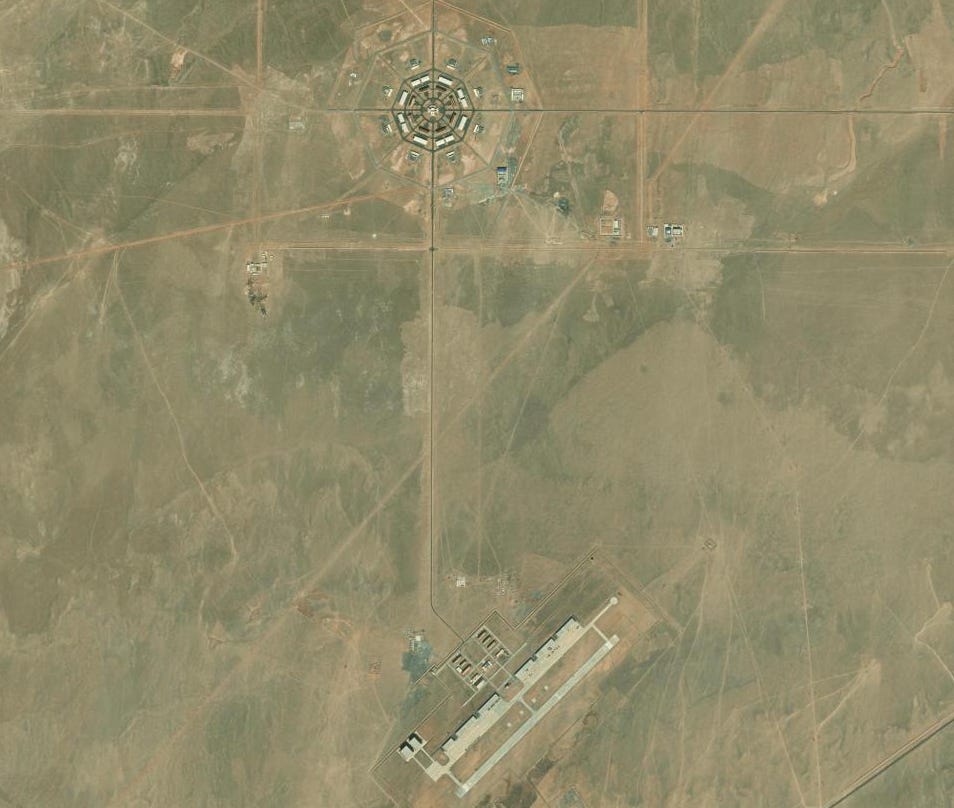
Site 1: 41°13’26.41”N, 91°30’1.65”E (Dated: 2025-09-11)
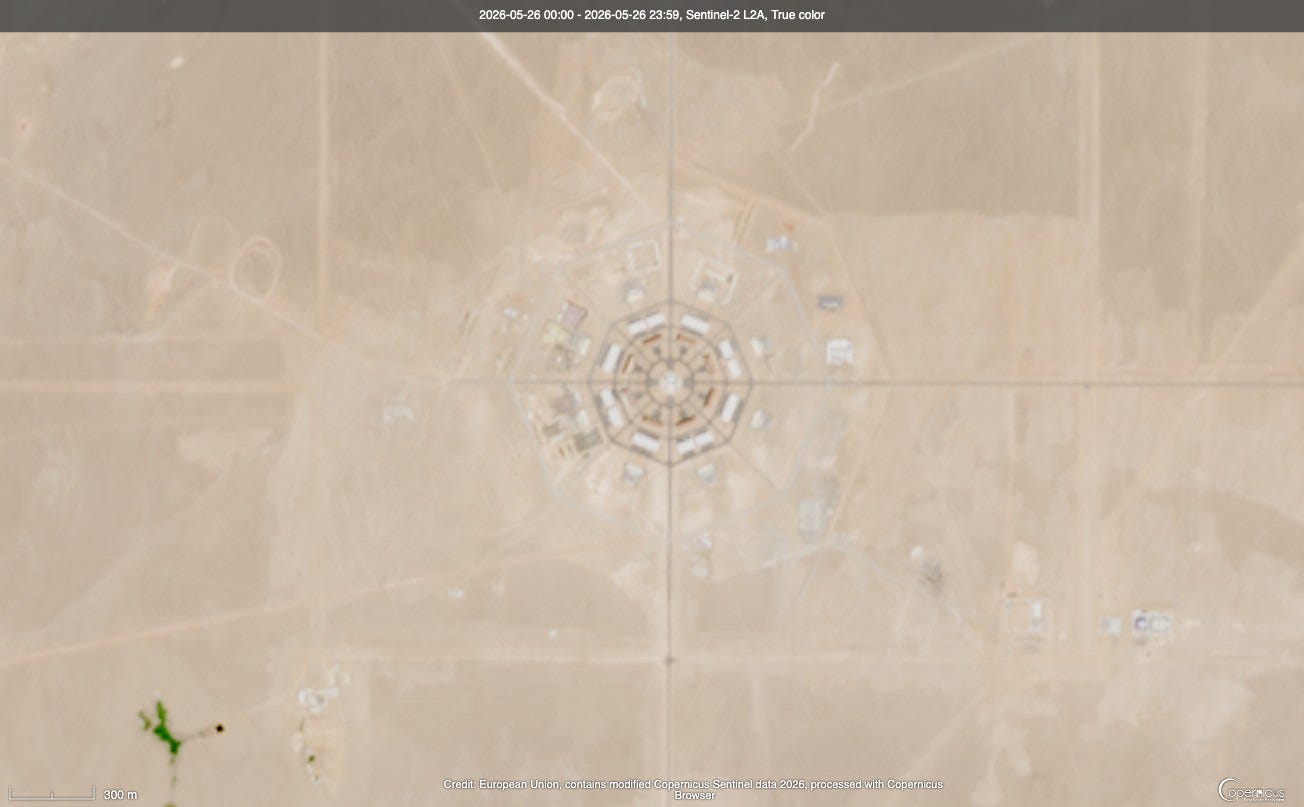
Site 1: 41°13’26.41”N, 91°30’1.65”E (Dated: 2026-05-26)
The Reuters revelation connects to a broader pattern of PLARF expansion documented in earlier original reporting for The Diplomat in October 2025, which found a new PLARF brigade taking shape near Golmud city on the Tibetan Plateau. That site features a central base compound linked by new roads to multiple prepared concrete launch pads in the configuration characteristic of road-mobile missile brigades. The Golmud site, under PLARF Base 64 headquartered in Lanzhou and associated with the 647th Missile Brigade, is assessed as likely deploying the DF-26, a dual-capable intermediate-range ballistic missile with a 4,000km range. Two officials from an Asian country confirmed the Golmud installations are linked to the PLARF’s broader force expansion and expressed concern about implications for India and Taiwan. Taken together, the Xinjiang silo network and the Tibetan Plateau brigade represent a geographic pincer: fixed ICBM deterrence in the north, and flexible road-mobile reach across South and Southeast Asia from the west.
Site 2: 40°25’32.79”N, 91°15’0.02”E (Timelapse)
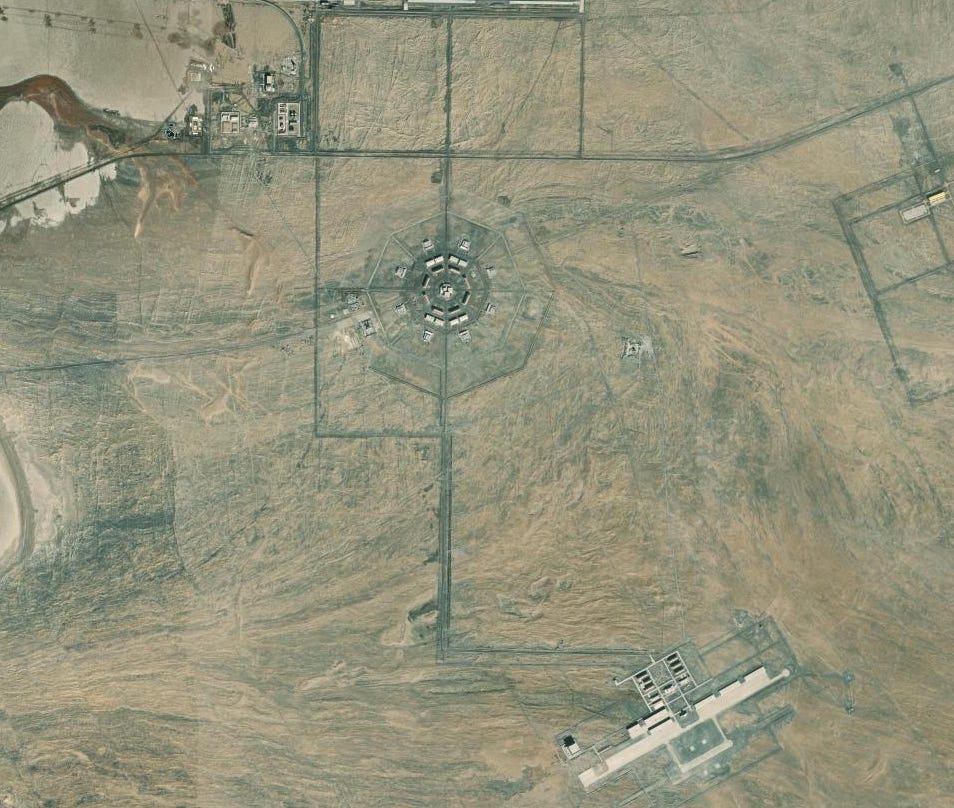
Site 2: 40°25’32.79”N, 91°15’0.02”E (Dated: 2024-02-09)
The disclosures build on a drumbeat of escalating revelations. A Pentagon draft report in December 2025 assessed that China had likely loaded more than 100 solid-fueled DF-31 ICBMs across its three main silo fields at Hami, Yumen, and Ordos, marking the first time Washington had put a specific deployment figure on record. China is on track to surpass 1,000 operational warheads by 2030, a pace faster than any other nuclear-armed state. Beijing has consistently denied these developments contradict its no-first-use doctrine and pledge to maintain forces “at the minimum level required for national security”, though the Pentagon has noted China is pursuing an “early warning counterstrike” posture and has shown no appetite for arms control talks.
Honest assessment: Much remains unknown about the intended purpose of these structures. There is a clear military dimension, with assets observed moving in and out. As with this author's earlier research on the Golmud area, a pattern is emerging of unusual new structures that appear linked either to conventional military forces, including storage and logistics, or to nuclear infrastructure such as rail connections and silo missile systems.