

Hello Readers,
Thank you for continuing to support the newsletter. Today, we dive deep into what happened at the Fifth Plenum, the recent China-India clashes in Arunachal Pradesh and how China is escalating tensions in the First Island Chain as U.S. Secretary of State Pete Hegseth made a trip to the region.
The Fifth Plenum, held from October 26-29, is the type of event that reflects China’s opaque political process, which, to the outsider, can appear to be merely a “political conference.” But reading between the lines and the slogans is what tells us what may be coming next for China and its leader Xi Jinping.
What did we learn from this year’s Plenum?
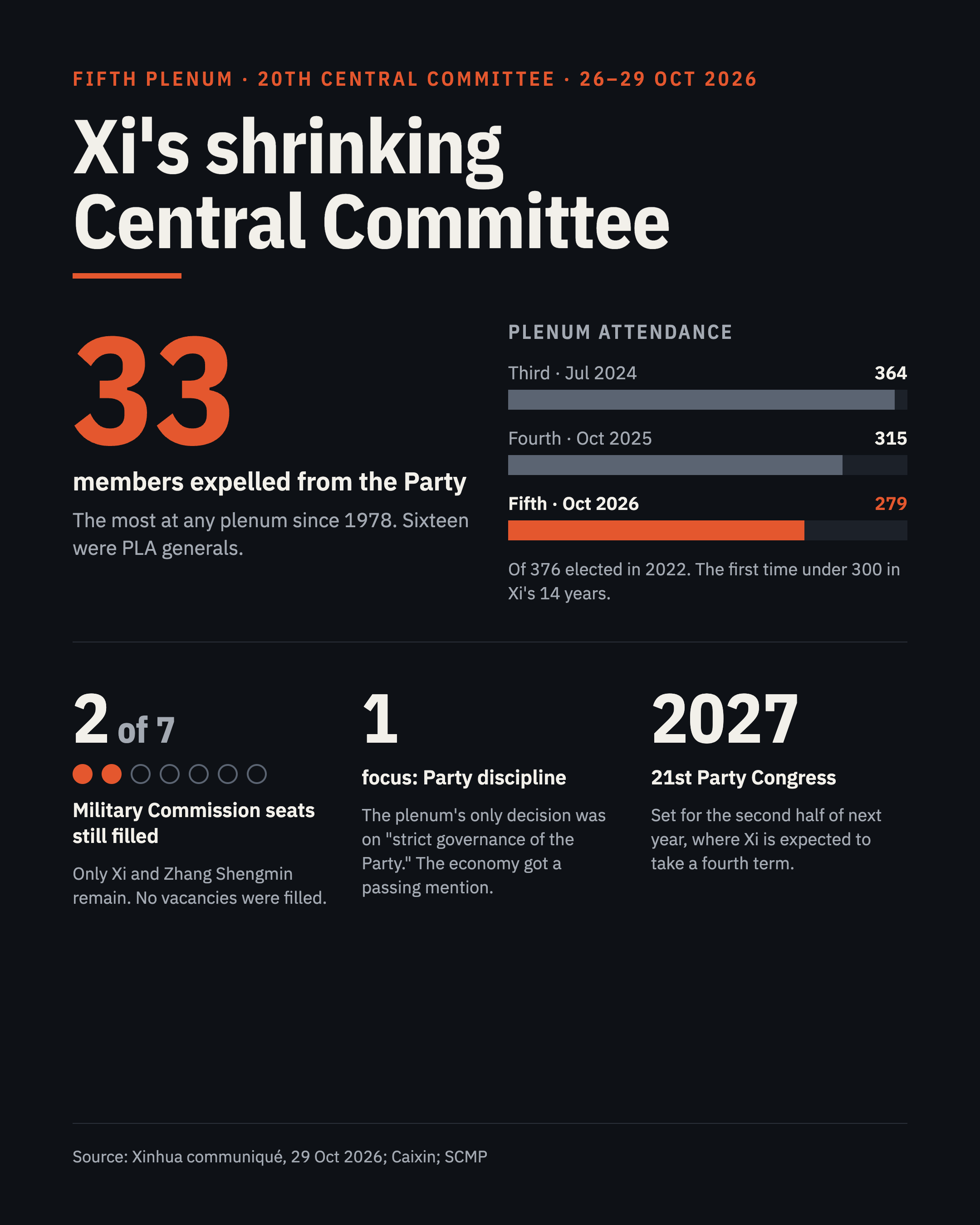
(Graphic made with Claude AI)
1. A record 33 Central Committee members were expelled from the Communist Party. That is the most at any plenum since reform and opening began in 1978. The Third Plenum expelled 3 and the Fourth 14. According to Caixin, the 33 were 24 full members and 9 alternates, and 16 of them were PLA generals. One more official, financial regulator Li Yunze, was stripped of his Party posts but not expelled. That brings the number dealt with at this plenum to 34.
2. The Fifth Plenum was attended by 279 Central Committee members: 162 full members and 117 alternates. That compares with 315 at the Fourth Plenum in October 2025 and 364 at the Third in July 2024. The 20th Central Committee was elected in 2022 with 376 members (205 full, 171 alternates), so only about 74% of the original body was in the room. It is the first time in Xi’s 14 years in power that attendance has fallen below 300.
3. The focus, unlike in the past, was discipline inside the Communist Party, not economic reform or social issues. The plenum’s main document was a Central Committee decision on “persistently advancing comprehensive and strict governance of the Party.” Last year’s Fourth Plenum handled the 15th Five-Year Plan. This year the economy got a passing mention.
4. One promotion, at the top of the military. Central Military Commission (CMC) vice-chairman Zhang Shengmin was elevated to the Politburo. He is now the only serving PLA officer on it.
5. A date for the next Party Congress. The 21st Party Congress will be held in Beijing in the second half of 2027. That is where Xi is widely expected to take a fourth term.
Now, the numbers tell the story themselves, from the high of 364 to a low of 279 people attending the plenary sessions in 2026. The purges by Xi are still a bit of a mystery but they have heavily affected the military as we know so far.
The purge and the PLA
Xi’s purges are still something of a mystery. The official charges are boilerplate: “serious violations of discipline and law,” and in some PLA cases factionalism and disloyalty. Beijing almost never says what anyone actually did. What we can see is who stopped appearing in public, and in this case the military has taken the heaviest blows.
The top of the PLA has been hollowed out. Xi began his third term in 2022 with six uniformed officers beside him on the Central Military Commission. Five are now gone: Li Shangfu, He Weidong, Miao Hua, and this year Zhang Youxia and Liu Zhenli. Zhang was the PLA’s most senior general and the son of a revolutionary comrade of Xi’s father. Liu ran the Joint Staff Department, the closest thing China has to a chief of the general staff. Both were placed under investigation in January and expelled in September, and the plenum formally confirmed their removal. That leaves the seven-seat CMC with two members, Xi and Zhang Shengmin. The plenum did not fill any of the vacancies.
The purge reached the machinery around Xi. The 16 generals expelled include two successive directors of the CMC General Office, Lieutenant Generals Zhong Shaojun and Fang Yongxiang. The General Office is the commission’s nerve centre, controlling paperwork, access and scheduling. Zhong was long seen as one of Xi’s most trusted military aides. Losing two directors of that office in a row is hard to read as anything other than a crisis of confidence at the very centre.
And into the defence industry. Seven of those expelled came from the military-industrial complex. They include Jin Zhuanglong and Lei Fanpei, both former deputy directors of the office that runs Xi’s signature military-civil fusion strategy. Combined with the generals, defence-related figures make up roughly 70% of this year’s expulsions.
Civilians were not spared. Former Politburo member Ma Xingrui was expelled. The communiqué from the Plenum also confirmed, for the first time, that former International Liaison Department chief Liu Jianchao had been investigated and removed from the Central Committee.
What does it add up to? CSIS had counted more than 100 senior PLA officers purged or possibly purged since 2022 even before this plenum. Optimists argue that Xi is clearing out a corrupt procurement system before it fails him in a real war. The darker reading is that the people Xi promoted himself keep failing his loyalty test. Either way, the PLA heads toward 2027, the centenary year by which Xi has ordered it to be capable of taking Taiwan, with an unprecedented gap in its senior command.
Here is an interesting quote from text of the agenda adopted after the plenary session:
“The plenary session put forward that promoting oneness without corruption and not wanting corruption is an important strategy for comprehensively and strictly ruling the Party and the basic policy of fighting corruption. We must keep in mind that the Party has no special interests other than the interests of the working class and the broad masses of the people, and the Party and corruption are incompatible; firmly take the road of anti-corruption with Chinese characteristics, strengthen the centralized and unified leadership of the Party Central Committee on anti-corruption work, pay more attention to both prevention and treatment, and systematically treat each other, adhere to strict punishment, precise treatment, effective prevention, and integrated grasp, and carry out the fight against corruption to the end.” “It is necessary to maintain the high-pressure situation of punishing corruption, strengthen the restrictions and supervision of the operation of power, consolidate the foundation of the idea of anti-corruption, and enhance the comprehensive effectiveness of promoting corruption without corruption.”
China and India go face-to-face in Arunachal Pradesh again
An Indian officials from the Indo-Tibetan Border Police (ITBP) named Shatrujeet Kapur, who leads ITBP, said during his retirement speech during a ceremony that there were face-offs at “several locations” that were still going on. It was first such confirmation of recent online rumors about military tensions between Chinese and Indian soldiers.