

Dear Readers,
This edition focuses on the quieter edges of the China-West-Taiwan rivalry, where espionage, technology, and supply chains increasingly overlap in plain sight. From Taiwan’s new tip portal to Beijing’s rebuttal of Five Eyes claims and the Jupiter Systems case, I see a shadow contest moving through websites, vendors, and civilian networks rather than only traditional state channels.
China-West espionage
Beijing turns the Five Eyes accusation back on the West
Chinese state media on Tuesday carried a sharp Defense Ministry rebuttal to Five Eyes claims that Chinese military intelligence has used online job platforms to recruit Western officials with access to classified material. In remarks published by Chinese state media, Defense Ministry spokesperson Senior Colonel Chen Xi called the allegation a politically motivated fabrication and said the Five Eyes countries had produced no evidence for what they describe as a “China spy threat.”
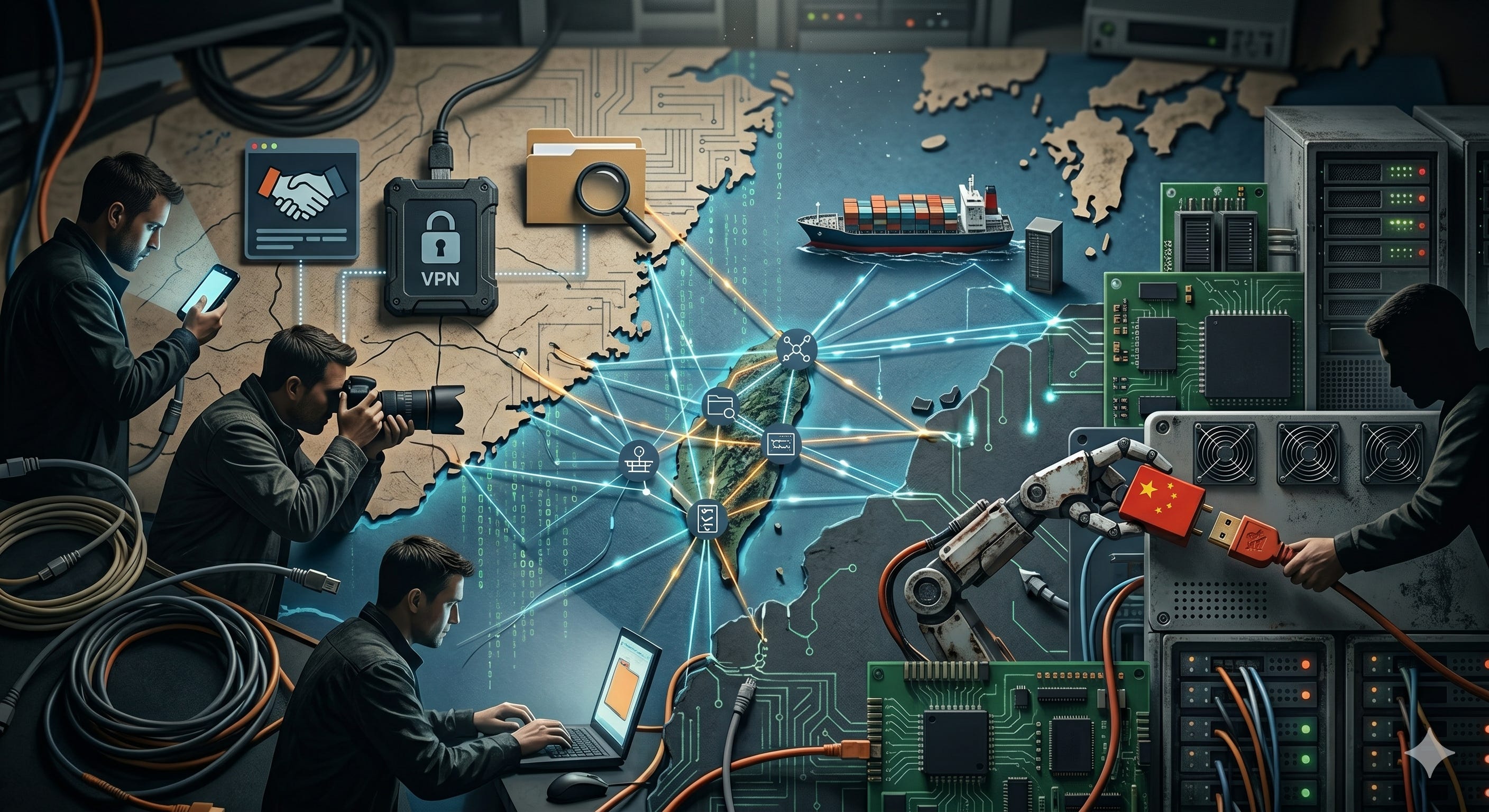
What makes this more than a routine denial, in my view, is that Beijing is trying to reverse the direction of the charge. Rather than simply rejecting the allegation, the Chinese side is arguing that the United States and its partners are the habitual practitioners of espionage, and Chinese official messaging in recent days has also warned that foreign intelligence services have tried to recruit photography enthusiasts inside China to take pictures of sensitive military sites and equipment.
I think that matters because it makes the episode look less like a clean case of accusation and rebuttal and more like a two-way espionage shadow war. The Five Eyes warning earlier this month described Chinese operatives as using professional networking and job sites to approach targets in government, defense, and related fields, while Beijing is now framing the West as using looser civilian channels of its own to gather military-related information inside China.
My read is that both sides are now fighting on two levels at once. One level is operational, where each suspects the other of using deniable civilian-facing tools to reach sensitive information. The other is narrative, where each wants outside audiences to see its own behavior as defensive and the other’s as manipulative, covert, and destabilizing.
What stands out to me most is how public all of this has become. Once intelligence accusations are pushed into official statements, alliance warnings, and state media messaging, the point is no longer just to stop a specific recruitment tactic. It is also to harden public opinion, justify tighter scrutiny, and normalize the idea that China and the Western intelligence bloc are locked in a persistent contest that now reaches into job boards, hobbyist networks, and the open internet.
Taiwan-China
Taiwan opens tip portal for mainland Chinese informants
What stands out to me here is that Taiwan is trying to turn China’s internal discontent into an intelligence opportunity, and it is doing so very publicly. Taiwan’s National Security Bureau launched an online “contact window” for Chinese nationals to submit political, military, economic, and social intelligence, saying the goal is to broaden its intelligence sources.
I read this as more than a technical move. Taipei is signaling that it believes there is a constituency inside China, or at least among Chinese abroad, that is disillusioned enough to cooperate if given a secure channel and clear operational guidance. The bureau has tried to lower the barrier by offering different instructions for users inside China and overseas, along with advice such as using foreign-brand devices, VPNs, and anonymous browsing.
To me, the bigger significance is that this is part of a widening information contest across the Taiwan Strait. Beijing previously launched its own reporting platform aimed at people accused of supporting “Taiwan independence,” and Chinese authorities said that system drew thousands of reports. That makes Taiwan’s new portal look less like an isolated initiative and more like a direct reply in an escalating battle over surveillance, narrative control, and psychological pressure.
Business and security
Behind the Screens
What struck me most in this piece is that the real story is not the screen technology itself but how quietly a small supplier can become embedded inside sensitive American systems before anyone treats it as a strategic problem. The Wire China reports that Jupiter Systems, a California maker of video wall processors used by every branch of the U.S. military, was acquired in 2020 by Beijing-based Suirui Group for $7.5 million without the deal being filed with U.S. authorities.
I think that matters because it shows how the front line of U.S.-China rivalry has moved far beyond the obvious targets like big chip firms or telecom giants. Once officials intervened, the Trump administration ordered Suirui to divest, and when that process stalled, a federal court placed Jupiter into receivership, which the article describes as the first such use of a court to enforce a presidential divestment order.
What I take from this is that Washington is now looking at ownership, procurement, and supply chain exposure as national security questions in their own right. The concerns in this case included Jupiter’s military customer base, Suirui’s ties to Chinese state-backed entities, Suirui’s reported pursuit of military business in China, and the risk that Chinese ownership could open a path to data access or disruption.
I also think the messiness of the unwind is part of the lesson. Even while U.S. authorities were trying to force a separation, Jupiter had increased sourcing from China after the acquisition, expanded staffing in Shenzhen, and still remained relevant enough that parts of the U.S. defense establishment resumed buying its products by late 2025 and again this year. To me, that is the clearest reminder that economic disentanglement sounds neat in policy speeches but looks much harder in the real supply chains that sit under national security.
Additional read: Foreign Affairs, “The False Promise of U.S.-China Stability,” argues that the current calm in U.S.-China ties under President Donald Trump is better understood as a shallow and fragile stalemate than as genuine strategic stability.