

Dear Readers,
There is too much happening across China and the wider region to keep up with everything.
That’s why I built Terton Watch.
It’s a simple, continuously updated feed tracking important developments across China, Taiwan, and the rest of East Asia.
The idea is straightforward: less noise, more signal.
If you follow China closely for work, research, journalism, or just want a better sense of what is happening, you can use Terton Watch as a quick way to stay on top of the news throughout the day.
It’s free to use.
Read Terton Watch:
tertonintel.com/watch
Terton Watch has its own archive of stories curated by date: https://www.tertonintel.com/watch/archive/
The China OSINT course course options are evolving. Please check out the new pricing and options: tertonintel.com/course
Now, the newsletter continues.
The Takeaway
Xi Jinping came to Washington for a second official state visit and left with something both governments can call “strategic stability.” That is a polite way of saying they already know the red lines and decided not to test them this week. The usable opening was trade and AI, and the usable result was process. On Monday, both sides published reciprocal lists of goods worth about $30 billion each, total $60 billion, that will get tariff cuts. China’s list covers 1,619 US items and the US list covers 77 categories of Chinese goods, and Beijing says over 90% of the products will move to standard “most-favored-nation” rates, effectively removing country-specific tariffs on them.
The overall effect is small, though. Capital Economics estimates the average US tariff on China falls only from about 22% to roughly 20.5%, and US soybeans were left off China’s list. The rest of the package was a short extension of the trade truce, a new AI incident channel, and two more leader meetings before year-end, which is why analysts at ING don’t expect a major trade flare-up before then. Chips, EVs and batteries were kept out of the deal, rare earths and Taiwan arms were left where they were, and a pending Section 301 probe into overcapacity could still bring new US tariffs.
Midterms did more work than the red carpet
Xi’s three-day state visit was sold as an effort to steady a relationship neither side can afford to break. The White House fact sheet says the two countries agreed to build a “constructive relationship of strategic stability” based on respect, fairness, and reciprocity. The wish for stability is real. What the visit did not deliver was any comfortable new equilibrium. Trade and AI were the only files either capital could actually move, and even there, the gains were modest.
Most of what happened took place offstage, and much of it followed the American political calendar. With the midterms five weeks away, the most visible deliverable was a pair of lists, each covering roughly $30 billion in goods, that will get lower tariffs. The US cuts land on things voters buy, such as toasters, toys, Christmas lights, and children’s car seats. China’s cuts target farm-state exports such as corn, wheat, sorghum, and meat. Both lists were released by the White House. As of this writing, Beijing has not published its own version, so the “each way” deal exists in writing only on the American side.
Around that sits a thinner package:
The trade truce was stretched by two months, to January 10.
The White House says China will take at least 10 million metric tons of US coal in each of 2027 and 2028.
There is a new channel for AI incidents, with an AI dialogue due in November.
Both sides pledged to speed up work on military crisis communications.
Both leaders plan to attend each other’s summits next, APEC in Shenzhen and the G20 in Miami, so expect the real bargaining to continue there.
Even the paper trail is split. There was no joint statement. Washington issued a fact sheet and Beijing published eight points of agreement. The White House said rare-earth shipments still need to return to “appropriate” levels, while China’s readout does not mention rare earths at all. Trump said the US would not give up its lead in AI. Xi, for his part, pressed Washington to go beyond its usual line and actively oppose Taiwan independence. The White House fact sheet simply left Taiwan out. The American response came afterward, when Ambassador David Perdue said US policy toward Taiwan was unchanged and that Washington does not want coercion.
Now, we have no idea what’s going to happen to the $14 billion US arms package for Taiwan that’s still pending. I don’t see the package getting a approval until the early next year as Trump and Xi are set to meet twice later in November and December for APEC and G20. I believe the US may approve the package in smaller tranches. Meanwhile, the opposition party in Taiwan, the KMT, has moved on while pointing out the delay exact proves their point that US is unreliable.
Rare earths did not move
US and China discussed critical minerals only as a problem to keep working on, which is another way of saying the controls are still in place. Beijing imposed licensing on key rare earths and magnets in 2025 during the tariff fight. The truce extension also prolongs China’s suspension of its rare-earth export controls, but Beijing made no new commitments. That means the relief lasts only as long as the truce, which now runs to January 10.
That would matter less if the US could refine and magnetize rare earths at scale, but it still cannot. Perdue has said that until the dependence is fixed, it is going to be a bumpy road, and he described a Manhattan Project-level push on rare earths to close the gap. Factories already feel the shortfall. So does the munitions pipeline, which is under strain from the Iran war. A Beijing-based commentary made the point bluntly this week: without the materials, replenishment gets ugly.
Taiwan: fewer aircraft, same water
The air picture around Taiwan has gone quiet by recent standards. August was one of the lightest months of 2026, about 171 PLA sorties, nowhere near the August spikes of the last two years. Some late-September days have been thin as well. On Sept. 26, Taiwan’s defense ministry logged five PLA aircraft, six navy ships, and five official ships over a 24-hour window.
The ships did not take the same holiday. Coast Guard and other government vessels have kept a higher baseline, including runs into restricted waters around Kinmen and a more regular presence east of the island. Taipei is still raising the defense budget, building drones, and embedding the coast guard more deeply in coastal defense. The big U.S. arms package is still under review.
So Taiwan is stepping back from the most telegenic pressure. It is not stepping out of the problem.
Carrier watch: everyone's home
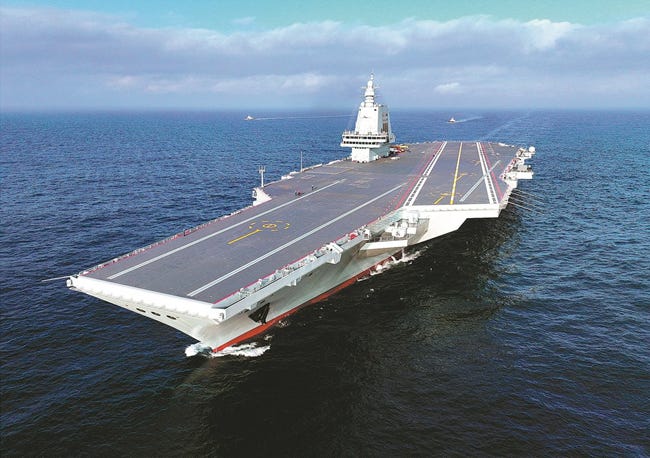
As of our last clean read (about 12:42 UTC, Sept. 29), none of China’s three commissioned carriers is out on a Western Pacific pressure run. All three are in port, and the fourth is still on the slipway.
Liaoning (CV-16) is back at Yuchi, Qingdao, after returning from the Western Pacific on 22 June 2026. High confidence, based on a PLA announcement and JMSDF reporting.
Shandong (CV-17) is at Yulin following late-August maintenance. Medium confidence, based on satellite imagery, OSINT and local reporting.
Fujian (CV-18) is at Yulin, Sanya, after a short training sortie in September. Our latest imagery is from 28 September. Medium confidence, based on Sentinel imagery and OSINT, with no PLA confirmation this cycle.
Type 004 has not yet been launched and remains in its building dock at Dalian, where satellite imagery from 4 to 28 September showed construction progressing on the bow and on the sponsons that will support the flight deck. High confidence, based on satellite imagery, Janes, SCMP and OSINT.
What it means: Fujian appears to have gone out, trained and come straight home, and we see no sign of two carriers at sea together this cycle. Taken alongside this week’s low air activity numbers, the pattern points to reconstitution and shipyard work rather than a show of force along the First Island Chain. That can change quickly, but it hasn’t changed this week.
China opens a joint air hub in Laos
While the Washington visit was still being digested, Beijing opened a new logistics and training site at Ban Keun Airport in Laos. China’s Ministry of National Defense said Tuesday that the China-Laos Joint Support and Training Center and the China-Laos Friendship Aviation Academy are now operating there. The stated job is to help train the Lao Air Force pilots. Both sites are described as jointly maintained.
The ministry did not say how many people or what aircraft and gear would be at the field. Reuters reported that the Lao embassy in Bangkok did not comment. Beijing’s line was the usual one: not directed at any third party, meant to deepen military cooperation and support regional stability.
The geography is the point. Ban Keun sits north of Vientiane. This is a rare overseas airside foothold, following the joint support arrangement at Cambodia’s Ream naval base and the logistics base in Djibouti. SCMP noted that it extends China’s still-thin overseas military presence deeper into mainland Southeast Asia. Some analysts already argue it looks more like Djibouti than Ream: a standing support node, not only a training talking point.
Put it next to the quiet Taiwan air picture, and the carriers in port, and the pattern is clearer. Pressure around Taiwan can be dialed down for a summit week. The slower work of building places where the PLA can train, support, and operate away from home does not pause.
Iran’s shopping list still runs through China and Hong Kong
A day after Xi left, Treasury designated 10 people and firms for allegedly helping Iran buy weapons and parts. The map includes China, Hong Kong, and Pakistan.
The administration is treating this as another turn of the isolation campaign against a war that started in February. Scott Bessent’s line was blunt: Treasury “will not tolerate any support to the regime.”
The names are the story for this region. Seyyed Asghar Alizadeh Tabatabai, described as a Beijing-based representative of Iran’s defense logistics ministry, allegedly lined up finished systems and dual-use components inside China. Kavoshcom Asia, in Iran, allegedly bought electronics, connectors among them, for Iran’s aircraft manufacturer. Hong Kong’s EC Mojo Technology and its China-based representative Li Fen were tied to those shipments. Waseem Pasha Tajammal, who chairs Pakistan’s Cavalier Group, was on the list too.
This is meant to raise the price of being a middleman. It is not a claim that the pipeline is dead. Brett Erickson at Obsidian Risk Advisors called the package “optics management” and said it would not stop missiles and drones in the Strait of Hormuz.
Iran barely featured in the summit beyond stock language on nuclear pledges and waterway tolls. The sanctions list is the part that actually touches East Asia.
Wang Wen recasts “百年未有之大变局” as Western entropy
Chongyang Institute dean Wang Wen (王文) argues that the Western-led order has entered runaway entropy (熵增). The new system is multipolar and Asia-centered, but not yet fixed. The piece ran on RT ahead of Valdai, then in Chinese on Guancha as “熵增!熵增!熵增!”
The Details:
The claim: Old rules have failed and hegemonic stability (霸权稳态) has broken. Three forces drive the shift: technology, a west-to-east move of geopolitical gravity, and competition that now includes cognition.
The six points, compressed: Power has “去中心化,” so cheap AI and autonomy flatten the old military generation gap. Nuclear weapons are regional bargaining chips, not a bipolar “恐怖平衡.” Economic and civilizational weight is shifting into a “泛欧亚经济循环圈.” U.S. credibility collapsed under transactional “America First” diplomacy. The real fight is the “无形战场” of narratives, aimed at “不战而屈人之兵.” Governance is migrating from the UN and IMF toward the SCO, BRICS, and regional resilience over “效率至上.”
The destination: America becomes a regional power. Multipolarity hardens. The prescribed fix is “东方共生之道,” framed as “熵减新生.”
Why It Matters: “熵增” makes U.S. disorder sound like physics and China’s rise sound like order returning. That is the narrative sitting under the tariff truce and the AI channel. If Valdai and later official texts keep the metaphor, it is the export version of Xi’s slogan.
Further reads:
Party Blames Zhang Youxia’s Fall on Disloyalty, Factionalism — Jamestown Foundation
China Appears To Be Building A Mothership For Large Uncrewed Submarines — The War Zone
Revolting for the CCP: seizing Taiwan could drive Japan to nuclear weapons — ASPI
See How the U.S. Is Attacking China’s Control of Critical Minerals — WSJ
The open-source AI platforms vying to become China’s Hugging Face — Rest of the World
China strengthens position for Taiwan conflict with mobilization law — Nikkei Asia Review
How an India-China military face-off triggered a $185mn loan freeze by Beijing — Indian Express
U.S. Military to Store Typhon Missile Launcher in Okinawa — Nippon
Xi’s Visit Will Fuel More Scrutiny Over His Health — NYT