

Hello Readers,
History is about to be made as U.S. President Donald Trump prepares to land in Beijing for the first time since his 2017 visit. In the intervening nine years, the world has witnessed a punishing trade war, a global pandemic, and a deepening sense of unease in Washington over China’s growing economic, technological, and military influence. This trip is not just a diplomatic formality; it is a potential turning point in one of the most consequential rivalries of the 21st century.
Exciting news for China watchers! I’m launching a new China OSINT course designed specifically for journalists, analysts, and researchers.
Master verifying Chinese media, tracking influence ops, and using China-specific tools — all in ~4.5 hours of self-paced video content with checklists and templates you can use immediately. Tier 2 adds satellite imagery training + certificate.
I have already had a few people sign up for early-bird pricing, which will remain open for another two weeks.
More details here:
Announcing China OSINT Course for Journalists, Analysts, and Policy Professionals
I’m excited to share that I’m opening enrollment for a new course on China-focused OSINT for journalists, analysts, and researchers. The course is built as a practical guide for people who want to investigate Chinese media narratives, track influence operations, verify claims, and develop repeatable research workflows.
Trump heads to Beijing for high‑stakes China visit
U.S. President Donald Trump will visit China from May 13 to 15 at the invitation of Chinese President Xi Jinping, China’s Foreign Ministry announced early Monday. The ministry posted the statement on the US social media platform X, confirming plans previously outlined by the US side.
The trip marks Trump’s first journey to China in almost nine years and is the first leader‑level visit from a sitting US president to Beijing since his own state visit in November 2017. Former US President Joe Biden did not travel to China during his term, leaving the bilateral relationship at the top level anchored in virtual summits and limited in‑person diplomacy.
Trump’s visit comes at a tense moment in the Middle East, where conflict triggered by US and Israeli strikes on Iran and its retaliatory attacks has raised fears of further escalation. The trip had originally been scheduled for March 31 to April 2 but was postponed so Trump could focus on managing the war in the region, and the crisis there is expected to be a central topic in the talks.
Relations between Washington and Beijing have grown increasingly strained during Trump’s second term, as the two sides spar over US tariff hikes, technology controls, and China’s tightening grip on rare earth elements, a sector in which it dominates global supply. In addition to the economy and technology, the two leaders are also expected to discuss Taiwan, which China claims as its own territory, following the recent US approval of large‑scale arms sales to the island.
The Rare Earths Deal Holds, For Now
A senior U.S. official confirmed on Sunday that the rare earths agreement between Washington and Beijing remains in force and has not lapsed, offering a measure of reassurance ahead of a critical diplomatic meeting. The statement came as President Trump and President Xi Jinping prepare to convene in Beijing on May 14 and 15, a summit that could determine whether the arrangement gets extended beyond its current timeline.
The deal in question was formalized in late October 2025 at a Trump-Xi meeting in South Korea, under which China agreed to suspend sweeping export controls on rare earth minerals for one year and begin issuing general export licenses. In return, Washington reduced tariffs on Chinese goods by 10% and suspended several Bureau of Industry and Security restrictions. The agreement is set to expire in November 2026, leaving roughly six months before both sides face the question of whether to renew it or let tensions resurface.
Despite the official optimism, the picture on the ground has been more complicated. Reports from late 2025 indicated that while China boosted deliveries of finished products like permanent magnets, American manufacturers were still struggling to source the raw inputs needed for domestic production. The official on Sunday acknowledged that discussions remain ongoing and that an extension, if any, would be announced “at the right moment”.
The Beijing summit will be closely watched for signals on whether both sides are willing to lock in a longer-term arrangement or let the deal drift toward expiration. With the November 2026 deadline on the horizon, industries from semiconductors to automotive to defense are waiting to see whether the current supply stability holds.
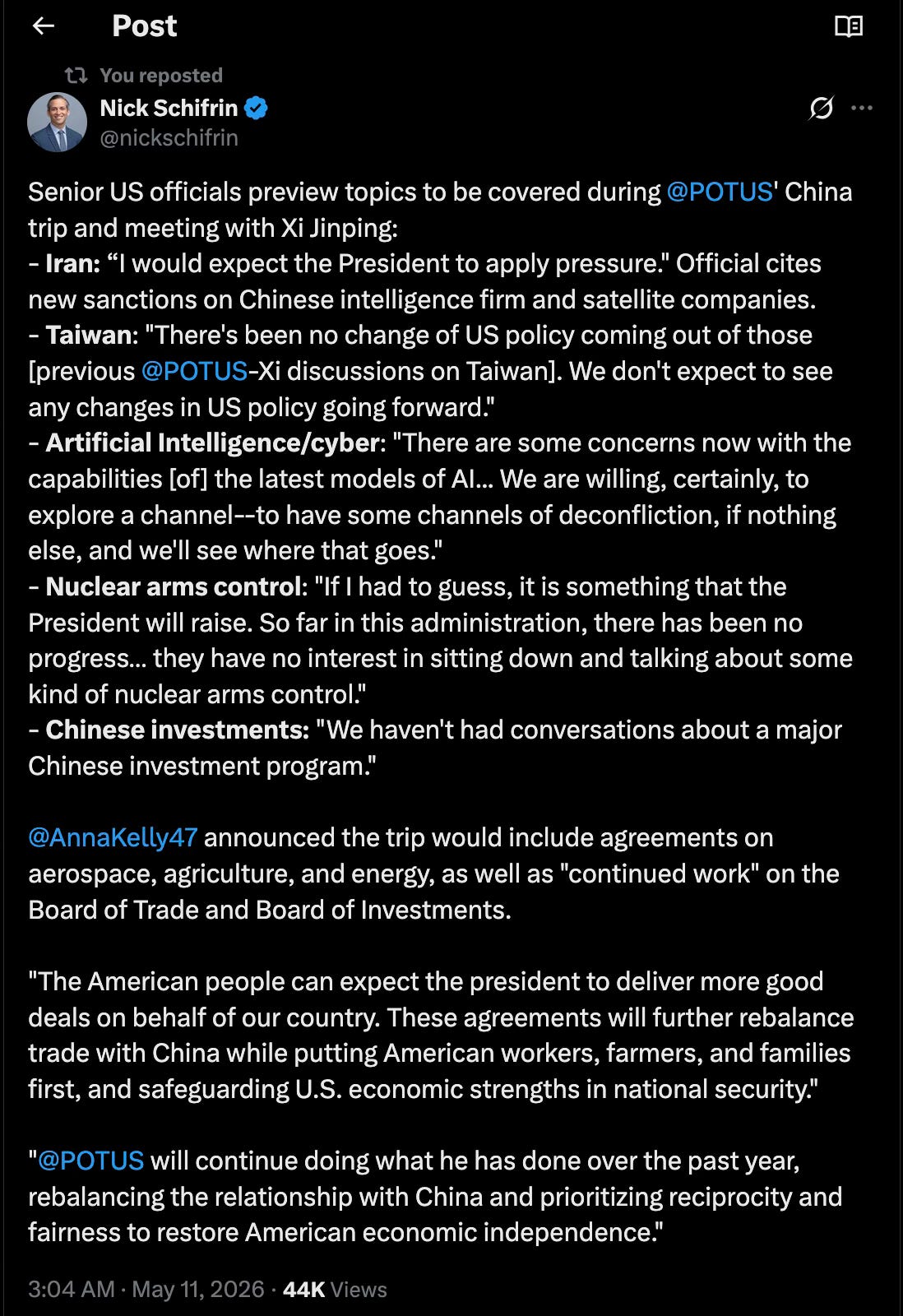
Ahead of President Donald Trump’s visit to Beijing, senior US officials have begun sketching out the tough‑tone agenda they expect to bring to the table in talks with Chinese President Xi Jinping. From Iran and Taiwan to AI competition and nuclear arms control, the White House is signaling that the meeting will be as much about managing rivalry as it is about securing limited cooperation.
Below is what officials are previewing, based on a tweet from Nick Schifrin of PBS NewsHour, which Asia Communique readers can also see alongside the photo.
Taiwan passes special defense budget but cuts key drone and air‑defense programs
Taiwan’s legislature has passed a special defense budget meant to upgrade the island’s air‑defense and missile capabilities, but it did so by sharply trimming the government’s broader plan in favor of narrowly defined US‑arms purchases. The result is a hybrid outcome: a politically significant boost to firepower against China, but with key indigenous and asymmetric programs left unfunded for now.
What was passed
Lawmakers approved a special defense budget of roughly NT$780 billion (about 24.8 billion dollars), about two‑thirds of the NT$1.25 trillion (roughly 40 billion dollars) package originally proposed by President Lai Ching‑te’s government. The enacted bill is structured around two main tranches:
NT$300 billion to fund US‑approved arms packages already cleared by Washington, including High Mobility Artillery Rocket Systems (HIMARS), M109A7 self‑propelled howitzers, TOW 2B missiles, Altius‑700M and Altius‑600 drones, and Javelin anti‑armor missiles.
NT$480 billion earmarked for a future US‑supplied arms package, contingent on Washington issuing letters of offer and acceptance (LOAs) and subsequent legislative review.
In practice, the passed budget is heavily skewed toward hardware that can be bought from the United States, with legislative approval tied directly to US‑certified sales lists rather than broad caps on capability‑type spending.
What was cut
The opposition‑led coalition deliberately excluded several elements of the administration’s original plan, arguing that the bill should focus on US arms and not on local industry development. The cuts affect three main areas:
Domestic industry and joint R&D
The legislature removed funding for Taiwan‑US technical cooperation projects, including joint research and development and deeper industrial partnerships that would have helped build a “client‑vendor” relationship with the US defense sector. The DPP and defense officials have warned that this undercuts the goal of an indigenous defense industry and could weaken long‑term trust with Washington.Unmanned systems and asymmetric capabilities
The approved bill omits or defunds significant portions of Taiwan’s drone and counter‑drone programs, including coastal surveillance drones, smart vertical take‑off and landing drones, and related counter‑UAV systems. Government and party officials say this effectively removes about 40 percent of the original budget earmarked for UAVs and anti‑ballistic missile interceptors, undermining asymmetric deterrence against mass missile and drone attacks.Integrated air‑defense and AI‑enabled command
Funding for the so‑called “T‑Dome” multilayer air‑defense network, AI‑boosted command and control, and related battlefield‑networking kits was also cut from the special budget. Senior officials argue that without these components, Taiwan’s ability to manage a high‑intensity air and missile campaign after a first strike is significantly degraded.
What happens next
The Executive Yuan has signaled it will seek a separate special budget act specifically for the programs that were cut, especially local defense‑industry projects and layered air‑defense systems, since adding them to the annual general budget would push national debt beyond the 15 percent cap set by the Public Debt Act. For now, however, the NT$780‑billion bill is the centerpiece of Taiwan’s effort to deter China, coupling a record‑scale US‑arms package with a political compromise that leaves critical gaps in its long‑term defense architecture.
Thanks!