

Hello Readers,
June 22, 2026
— Aadil Brar
In this afternoon’s edition: Seoul pitches a “pragmatic” nuclear roadmap to Trump, Taiwan starts assembling its U.S. SkyGuardians, the U.S. deploys its powerful Typhon missile system to Japan, and Beijing rolls out surgical export controls targeting the U.S. drone base.
1. Seoul’s “phased pragmatism” meets Trump
The News: South Korean President Lee Jae-myung presented U.S. President Donald Trump with a step-by-step roadmap for North Korean denuclearization during a G7 dinner in France.
The strategy: Prioritize a near-term freeze on Pyongyang’s nuclear activities over an immediate, all-or-nothing disarmament demand.
The concessions: Short-term benchmarks include halting additional fissile material production, blocking overseas weapons transfers, and stopping ICBM development, leaving full denuclearization as a long-term target.
Trump’s take: He reportedly expressed openness, noting it “could be one way” forward and agreeing to consider it.
Why it matters: The proposal acknowledges that traditional sanctions have failed, especially since North Korea-Russia military cooperation over the Ukraine war has bypassed Western financial pressure.
By the numbers: North Korea continues to produce enough fissile material to build 10 to 20 nuclear weapons annually, with its ICBM technology nearing final re-entry capability.
The Backlash: Pyongyang is not playing along. Kim Yo-jong issued a sharp statement via the KCNA denouncing the G7’s denuclearization calls as a direct violation of North Korea’s constitution, which legally enshrines its nuclear status. She declared the regime’s nuclear status “irreversibly finalized” and warned that tampering with it means “inviting disaster”.
2. Taiwan begins assembling U.S. “SkyGuardians”
The News: Taiwan has received its first two MQ-9B “SkyGuardian” high-altitude surveillance drones from the U.S., with assembly and ground testing currently underway on the island.
The background: Part of a 2020 U.S. Foreign Military Sales agreement worth NT$21.7 billion (approx. US$685 million) for four MQ-9B SeaGuardian UAVs. The first two have been delivered; the remaining two are scheduled for delivery in 2027.
The role: Unlike the U.S. military’s strike-first deployment, Taipei intends to use the drones for high-risk tactical reconnaissance and round-the-clock surveillance against Chinese gray-zone maritime activity.
Why it matters: The MQ-9B is designed for information dominance.
Allied Integration: The drone can link directly to secure satellite communications networks shared among U.S. allies.
Deterrence: If a cross-strait conflict erupts, Taiwan, the U.S., and Japan can instantly share real-time targeting telemetry to strike Chinese vessels trying to enforce a blockade east of Taiwan.
3. U.S. deploys powerful “Typhon” missile system to Japan
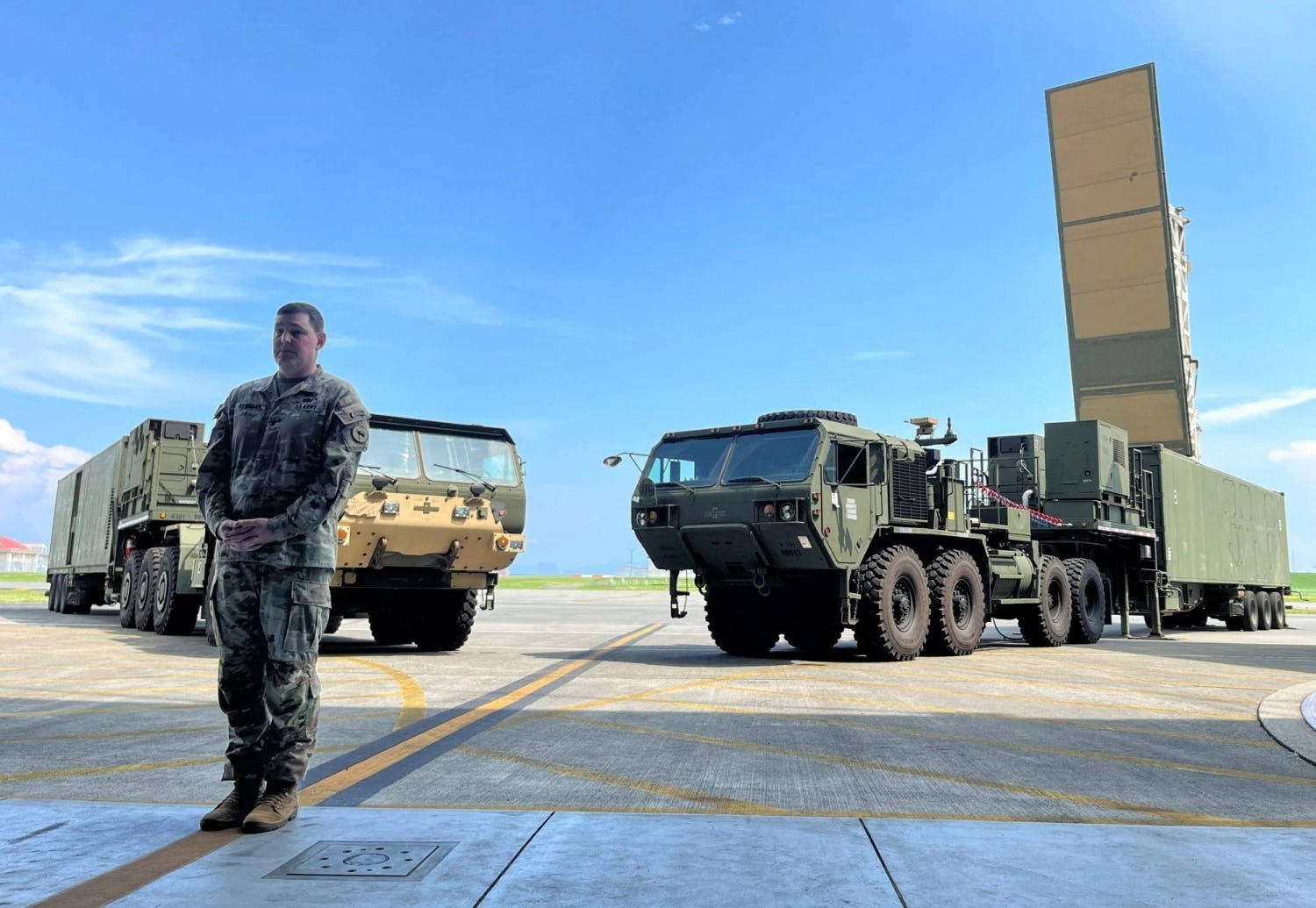
The News: The U.S. military is deploying its land-based Typhon midrange missile system to Kagoshima Prefecture in southwestern Japan for joint drills, breaking long-standing postwar taboos.
The drills: The system will participate in Valiant Shield exercises at Kanoya Air Base from Monday through July 1, followed by Orient Shield drills in September.
The transition: After the drills conclude, the system is slated to move to a U.S. military base in Japan in mid-October, which officials emphasize is a non-permanent deployment.
The arsenal: Typhon can fire Tomahawk cruise missiles with a range of up to 1,600 kilometers—effectively placing parts of mainland China within striking distance—as well as SM-6 air defense missiles.
Why it matters: This is only the second time the Typhon system has been deployed to Japan, signaling a gradual shift in Tokyo’s “exclusively defense-oriented policy” to allow strategic offensive weapons for joint deterrence rehearsals.
Beijing’s pushback: China has lashed out, calling the deployment “yet another example of Japan’s accelerated remilitarization” and warning that it harms regional strategic security and heightens confrontation risks.
4. Beijing warns of pop-up espionage and technical “jigsaws”
The News: China’s Ministry of State Security (MSS) has escalated its public counterintelligence campaign, warning that foreign spy services are exploiting pop-up advertisements to harvest user profiles and location data.
The mechanism: Foreign agencies collude with commercial ad firms, routing data through neighboring regional nodes to bypass Chinese firewalls. When a user accidentally clicks an ad, their personal profiles, location, and behavior are sent back, allowing spy agencies to construct high-precision profiles for targeted recruitment.
The case: The MSS publicized the case of a defense researcher, surnamed Zhang, who was recruited abroad under an academic consultancy facade by foreign operatives Bu and Mai. Zhang became suspicious after returning to China when they pried into military hardware research, leading him to self-report. He was spared prosecution, illustrating Beijing’s effort to incentivize public reporting.
The Big Picture: The MSS is warning citizens about cumulative, “jigsaw-style” intelligence gathering. Beyond digital profiling, foreign spies are reportedly using online platforms to recruit local actors for “paid photography” at air shows and electronics exhibitions to reconstruct stealth coating parameters and circuit designs.
5. Beijing hits back at U.S. drone and rare earth base
The News: China’s Ministry of Commerce (MOFCOM) has added 10 U.S. entities to its export control list, prohibiting the transfer of Chinese-origin dual-use items to them.
The trigger: Retaliation for the U.S. Department of Defense’s expansion of its Section 1260H Chinese Military Companies list, which recently blacklisted tech giants Alibaba and Baidu. Beijing noted this violates the Xi-Trump consensus reached in May 2026.
Government Ban: Concurrently, the Ministry of Finance announced a sweeping procurement ban prohibiting Chinese government agencies from purchasing products from 46 U.S. firms (including divisions of Lockheed Martin, Raytheon, and Boeing).
Why it matters: Beijing is surgically targeting the critical middle tier of the U.S. defense-industrial and rare earth supply chains:
Rare Earth Squeezing: Target companies like MP Materials and USA Rare Earth are blocked from importing Chinese chemical extraction agents and refining tech, threatening domestic U.S. critical mineral supply chains.
Drone Supply Disruptions: Drone manufacturers and component suppliers—including Teal Drones, Red Cat Holdings, IMSAR (radar), Aveox (brushless motors), and Jaia Robotics—face immediate cut-offs of lightweight composites, precision magnets, and marine sensor components.
Tactical Mobility: Fleet vehicle provider Oshkosh Defense and satellite payload maker Ball Aerospace are hit with blocks on dual-use metallurgical inputs and optical processing sensors.
PDR (Pacific Defense Review)
Seoul: President Lee Jae-myung secured a commitment from Pope Leo to actively consider a visit to South Korea, the DMZ, and potentially North Korea to foster peaceful engagement.
Taipei: The Air Force’s fiscal 2026 defense budget proposal includes plans to develop an uncrewed aerial system capable of round-the-clock surveillance to track PLA gray-zone activity.
Beijing: The Ministry of Finance’s sweeping procurement ban against 46 U.S. defense and tech firms will exclude U.S.-funded enterprises operating inside China.
Washington: Department of Defense restrictions under the expanded Section 1260H list—which sparked Beijing’s retaliatory export controls—are scheduled to take effect on June 30, 2026.
Reads:
China Could Win Taiwan Without Fighting — Foreign Affairs
The Amari Bangkok, a hub for security diplomacy — Intelligence Online
Xi’s Enforcers Are Hunting Down Officials Who Consult Mystics and Borrow Too Much — WSJ
New Activity at Possible Chinese Intelligence Facilities in Cuba — CSIS