

Hello Readers,
Beijing is significantly accelerating its cross-domain power projection, testing geopolitical limits with a series of coordinated maritime and aerial maneuvers. As China’s premier indigenous supercarrier sails through the Taiwan Strait and state media broadcasts advanced stealth fighter-drone pairings, pressure is mounting across the First Island Chain—particularly over a newly contested structure at Scarborough Shoal.
Meanwhile, in Washington, a landmark Supreme Court ruling has cut off a primary avenue for corporate liability for human rights violations by tech companies, redefining the legal landscape for tech operations.
1. SCOTUS slams door on overseas corporate liability.
The Big Picture: The U.S. Supreme Court has dealt a final blow to a 15-year-old legal battle, ruling in favor of tech giant Cisco Systems and shielding American corporations from being sued in U.S. courts over foreign human rights abuses.
The Details: The Case: Filed in 2011 by members of the Falun Gong spiritual movement, the lawsuit alleged that Cisco custom-engineered China’s “Golden Shield” surveillance system. Plaintiffs argued Cisco knew the technology would be used to track, detain, and torture believers.
The Ruling: Reversing a lower appeals court, the Supreme Court determined that U.S. courts are the wrong forum for actions orchestrated by foreign governments on foreign soil, even if a significant portion of corporate planning happened in the U.S.
The Legal Mechanism: The ruling heavily restricts future applications of the 18th-century Alien Tort Statute (ATS) and the 1991 Torture Victim Protection Act (TVPA) against American companies operating globally.
The Dissent: Justice Sonia Sotomayor strongly disagreed with the majority, writing that the decision effectively “closes the courthouse doors” to corporate accountability, noting that arguments strongly suggested Cisco was aware its systems would facilitate torture.
Cisco’s Take: The company maintained that it simply sells standard networking infrastructure and cannot be held responsible for how sovereign nations choose to utilize it.
2. Island-building fears reignite as China places new structures at Scarborough Shoal
The Big Picture: High-stakes maritime brinkmanship between Manila and Beijing has taken a sharp turn. Philippine defense officials are sounding alarms that Beijing may be laying the groundwork to turn the heavily contested Scarborough Shoal into a permanent military outpost, threatening to rupture long-delayed South China Sea Code of Conduct talks.
The Details:
The Catalyst: The Philippine government lodged a formal diplomatic protest after detecting several large, unannounced floating structures inside the lagoon of Scarborough Shoal. Manila suspects these platforms, deployed by Chinese research vessels, are pretexts for permanent surveillance or communications installations.
Beijing’s Pretext: The deployment follows China’s unilateral move to declare a 3,500-hectare “national nature reserve” over the reef—a designation Manila slams as a legal cover for full physical occupation.
The Swarm: The Armed Forces of the Philippines reported tracking a staggering 82 Chinese coast guard and naval vessels within the Philippine Exclusive Economic Zone (EEZ) over the last month alone, with nearly half concentrated solely around Scarborough Shoal.
The Allied Counter: The U.S. responded by announcing a $13 million delivery of “Triton” autonomous underwater and surface vehicles to the Philippines. These long-endurance, solar-powered maritime drones are designed to dive under the surface to avoid detection while providing Manila with constant, unblinking reconnaissance on Chinese island-building activities.
The Bottom Line: Scarborough Shoal represents the final “strategic gap” for China in the central South China Sea, sitting just 200 kilometers from the main Philippine island of Luzon. If Beijing successfully converts the atoll into a militarized base alongside its existing outposts on Subi and Mischief reefs, it will secure a chokehold over regional shipping lanes and effectively freeze the Philippines out of its own EEZ.
3. China’s dual-carrier push: Fujian transits Taiwan Strait as Liaoning logs blue-water drills
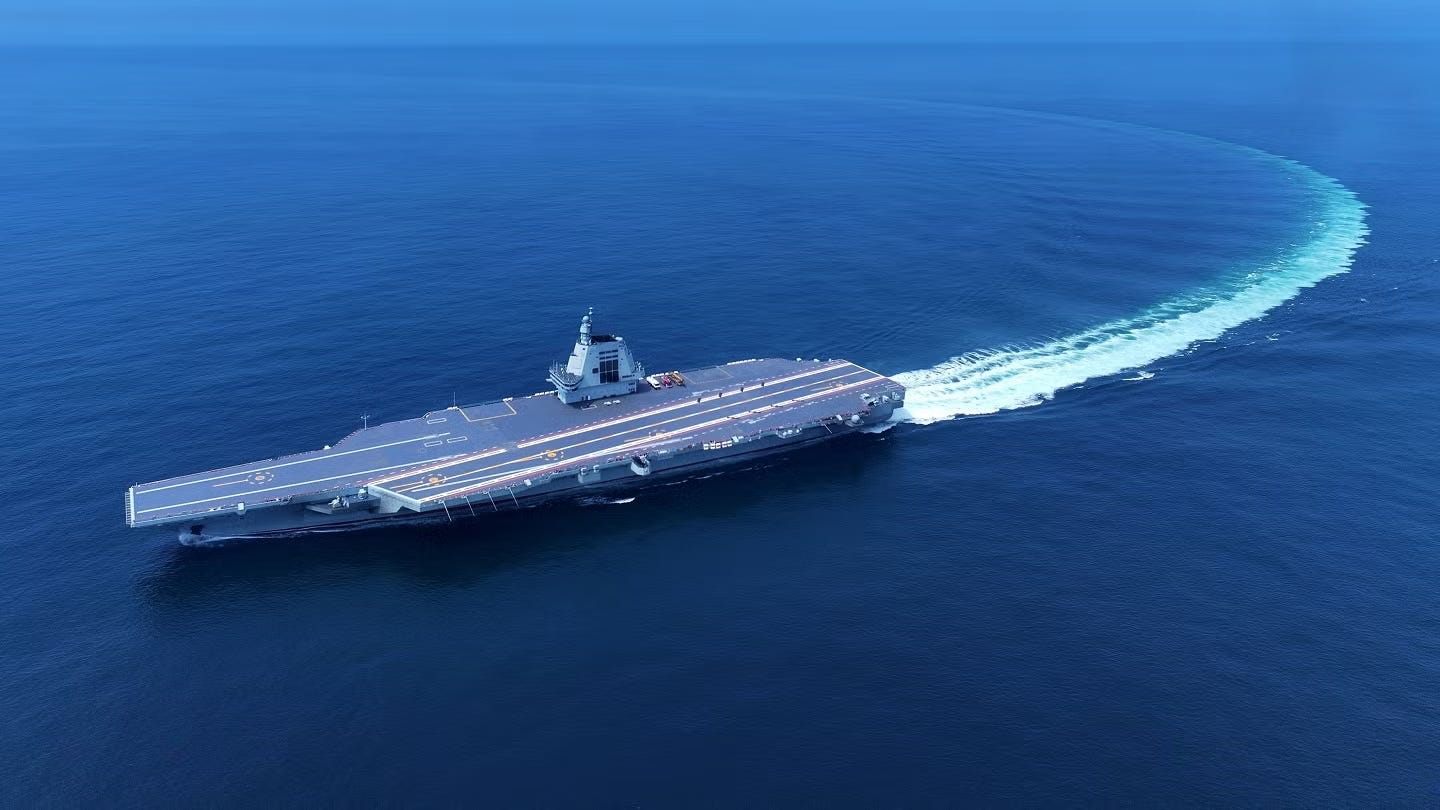
The Big Picture: Beijing is flashing its naval muscle across the region. Just as China’s first carrier, the Liaoning, wrapped up an aggressive 40-day deep-sea mission, its newest and most advanced aircraft carrier—the Fujian—sent a sharp geopolitical signal by sailing directly through the sensitive Taiwan Strait.
The Details:
The Fujian Transit: Taiwan’s Ministry of National Defense reported that the Fujian transited the strait on Tuesday, marking its first mission through the waterway since April. Taipei deployed joint intelligence, surveillance, and reconnaissance assets to shadow the ship, releasing an overhead photo showing a clear but aircraft-free flight deck.
The Liaoning Drills: Concurrently, the Liaoning returned to port in Qingdao after its 40-day combat deployment spanning the South China Sea and Western Pacific. This mission successfully tested integration with Type 075 amphibious assault groups and land-based tanker aircraft to significantly extend the PLA’s operational envelope.
Why the Fujian Matters: Unlike its predecessors, the Fujian features a flat flight deck equipped with cutting-edge electromagnetic catapults. This allows it to launch significantly heavier, more heavily-armed jet fighters at a much faster rate, moving China closer to true U.S.-style power projection.
Between the Lines: The timing is surgical. The Fujian’s transit occurred just one day after Taiwan kicked off a critical five-day military exercise designed to simulate responses to a full-scale Chinese invasion. Furthermore, it follows a new grey-zone pressure tactic from Beijing: deploying Chinese coast guard vessels along Taiwan’s east coast to artificially project jurisdiction.
The Bottom Line: Beijing is no longer just experimenting with isolated carrier operations. By simultaneously demonstrating advanced far-sea combat integration with the Liaoning and flexing its premier, indigenously-designed supercarrier through the Taiwan Strait, the PLA is signaling that its “system-of-systems” maritime dominance strategy is approaching full operational maturity.
4. Beijing flexes full-stealth aerial combo: J-20S teams up with Attack-11 drone
The Big Picture: China’s state broadcaster (CCTV) broadcasted a deep-dive showcase on the PLA Air Force’s latest paradigm shift in aerial warfare, highlighting how the newly unveiled J-20S—the world’s first two-seat fifth-generation stealth fighter—is actively integrating with the Attack-11 (Gongji-11) stealth combat drone.
The Details:
The “Loyal Wingman” Concept: State media highlighted the combat reality of teaming the J-20S with the Attack-11, a flying-wing stealth UAV designed for deep penetration strike missions.
The Division of Labor: In this configuration, the front-seat pilot of the J-20S focuses on flying and traditional aerial combat, while the rear-seat officer serves as an airborne command-and-control operator, actively managing a swarm of Attack-11 drones ahead of the formation.
System Strength: CCTV explicitly pitched this pairing as a showcase of the PLA’s “all-stealth aerial combat system architecture.” The drones act as forward sensory extensions—jamming enemy radars, scouting high-threat environments, or drawing missile fire—keeping the crewed mother ship safe from retaliation.
Why It Matters: While the U.S. Air Force continues to develop its own Collaborative Combat Aircraft (CCA) program to pair drones with next-gen fighters, Beijing is signaling it has leaped ahead in real-world deployment by fielding a dedicated two-seat stealth airframe (the J-20S) specifically built to manage the heavy cognitive load of drone-swarming operations. It complements China’s maritime dual-carrier flex by showing an equally advanced, cross-domain power projection capacity in the skies.