

Hello Readers,
We’re continuing to build and refine the China OSINT course—and it’s quickly evolving beyond its original format. What started as a focused training resource is becoming a more dynamic, continuously updated toolkit for researchers working with Chinese-language sources.
In the coming weeks, I’ll be rolling out new features, expanded modules, and practical workflows designed to make investigations faster, more reliable, and accessible even without Mandarin fluency. The goal is simple: create a living resource that grows alongside the changing Chinese information environment.
If you sign up now for Tier 2, you’ll also get early access to some of the upcoming verification tools and new features as they are released.
If you haven’t explored the course yet, you can learn more here: https://www.asiacommunique.com/p/announcing-china-osint-course-for.
The newsletter follows below.
The number that should worry people is this: roughly 90 percent of Russian missiles and drones examined by Ukrainian investigators contain Japanese-made electronics. That detail pulls together a much bigger story. The region is no longer being shaped only by summits, speeches, or military drills. It is being shaped by supply chains, intelligence networks, detention cases, arms sales, and chip investment, with pressure building across Taiwan, Japan, China, and the wider Indo-Pacific.
South China Sea pushback
On the 10th anniversary of the 2016 arbitration ruling, 14 countries including the U.S., Japan, Australia, Canada, Britain, Germany, and Italy issued a joint statement rejecting China’s maritime claims and reaffirming the ruling’s finality under international law. The statement also highlighted dangerous China Coast Guard maneuvers near Philippine features, which made it more than a ceremonial anniversary statement.
Beijing dismissed the move and accused the countries involved of stirring up trouble. That matters because it shows the central contest is still over whether China can normalize its claims through constant presence, while the U.S. and its partners are trying to draw a legal and diplomatic line that keeps those claims from hardening into the regional baseline.
Tech blacklists keep tightening
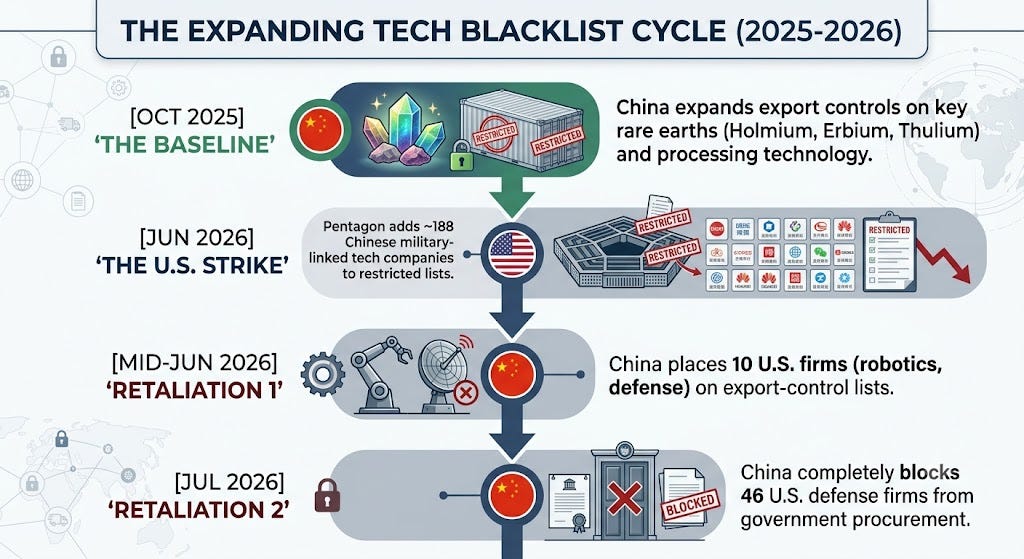
The U.S. and China are still locked in a mutual blacklist cycle that is spreading from industrial policy into national security. In June, the Pentagon added about 188 Chinese military-linked companies focused on advanced technology, while China retaliated by placing 10 U.S. firms in robotics, rare earths, and defense on export-control lists and blocking 46 U.S. defense-related firms from government procurement.
China has now expanded its rare earth restrictions again, adding holmium, erbium, thulium, europium, and ytterbium to the export-control list, along with related processing equipment and technology for mining, smelting, separation, magnet production, recycling, and production-line upgrades. The latest move also tightens scrutiny on defense end users and advanced semiconductor-related exports, making the policy less about raw materials alone and more about control over the industrial chain that depends on them.
This is no longer just trade friction. It is a slow conversion of strategic industries into sanctions terrain. That raises costs, disrupts supply chains, and pushes more countries into the uncomfortable position of having to hedge between the two sides.
Taiwan’s drill is the real signal
The biggest Taiwan story right now is not a new Chinese move. It is Taiwan’s own defense posture. Taiwan is in the middle of its longest-ever Han Kuang exercise, a 10-day, 9-night drill running from July 9 to 18, with the full combat phase taking place from July 13 to 18. The exercise covers anti-landing operations, coastal combat, defense in depth, and long-duration warfare scenarios.
This year’s drill is especially notable because Taiwan is using it to test both hardware and command structure. The exercise includes U.S.-supplied HIMARS, Tien Chien II air-defense missiles, TOW 2B anti-armor missiles, drones, and M1A2T Abrams tanks, while more than 22,000 reservists are involved. President Lai personally watched the tank live-fire drill, where four M1A2T tanks reportedly hit every target, underscoring that Taiwan is trying to show not just equipment but confidence in how it uses it.
A new detail from Focus Taiwan adds another layer. On Monday, Taiwan’s military launched a separate joint defense exercise featuring Marine Corps mobilization operations to reinforce the Taipei metropolitan area, with scenarios that include hostile vessels entering Taiwan’s territorial waters and the integration of the three services. That matters because it shows Taiwan is not just rehearsing battlefield tactics in the abstract. It is also practicing how to defend the capital and how to link maritime warning, joint command, and urban response in a real crisis.
The M1 tanks matter for more than symbolism. Taiwan bought 108 M1A2T tanks from the U.S. in a $1.45 billion deal, and the first 38 have already been delivered, with the rest still coming in stages. In practical terms, the tanks strengthen Taiwan’s ability to defend key areas, while the live-fire debut signals that Taipei wants to integrate these systems into wartime planning, alongside drones and other newer systems.
PLA activity around Taiwan has stayed more controlled than dramatic. In June 2026, Taiwan tracked 208 PLA aircraft sorties around the island, down sharply from 499 in June 2025. Median-line crossings fell to 36, and no bomber flights were recorded, even as the PLAN maintained a steady daily presence of five to 10 vessels. Beijing is keeping up the pressure, but it is not trying to steal the spotlight from Taiwan’s drill with a major spike.
Japan becomes a security node
Japan now sits inside the same strategic picture, but in a different way. It is both a target for foreign intelligence activity and a country trying to rebuild its own intelligence system. A New York Times investigation says Russian military intelligence used Japan as a procurement hub for electronics and dual-use components for missiles and drones, despite sanctions. Some GRU operatives reportedly moved there after the mass expulsion of Russian diplomats from Western countries in 2022.
Tokyo is trying to close that gap. Japan is standing up a new national intelligence agency to coordinate roughly 33,000 personnel across government, following earlier legislation that created a National Intelligence Council and a National Intelligence Bureau structure. Japanese officials have already acknowledged the need to do more against foreign intelligence activity. That makes the Russia story more than a sanctions scandal. It is one of the clearest reasons Japan is now rebuilding its intelligence capacity.
China detains a U.S. seismologist
There is another intelligence angle here that is easy to overlook but important. Reuters reported that China has detained an American seismologist who studied North Korean nuclear tests, and she has reportedly been held for nearly two years. Chinese officials also reportedly questioned her husband more than 100 times about his work on nuclear test signatures.
That case shows how quickly technical and scientific work can become politically sensitive. It also fits the broader pattern in this briefing. States are treating access to expertise, technical data, and scientific research as a security issue, not just an academic one.
What to watch
- Whether Beijing responds to the South China Sea anniversary statement with new Coast Guard activity near the Philippines or Taiwan.
- Whether the Taiwan arms package moves or stays stuck in U.S.-China bargaining.
- What Taiwan’s Han Kuang exercise shows about reserve mobilization, drones, and decentralized command.
- Whether Japan will tighten export enforcement after the Russia procurement reporting.
- Whether the detained U.S. seismologist case becomes part of a broader North Korea or U.S.-China security dispute.