

Hello Readers,
Two things happened in the same week that look unconnected but aren’t. Taiwan wrapped up the live fire phase of its largest war games since 1984, and the Pentagon’s chief Indo-Pacific strategist stood in Manila and told Southeast Asia that America is “not leaving,” but also isn’t interested in being anyone’s protector for free. Read together, they sketch the shape of Washington’s actual Asia policy in 2026: less about new guarantees, more about who is willing to prove they can fight.
Han Kuang exercises underway from August 5 to August 14, 2026 are much more comprehensive and based on principles of preparing for real conflict.
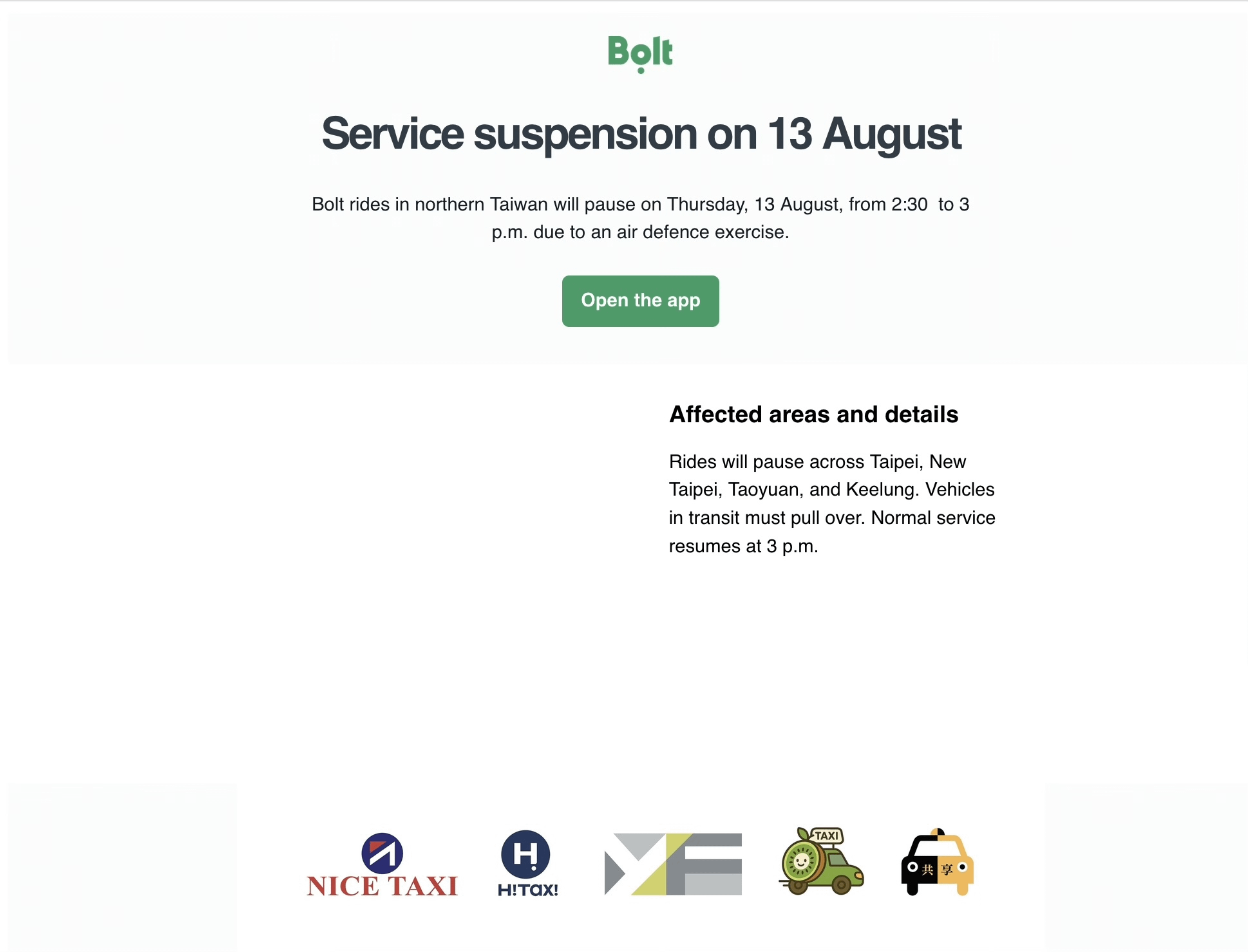
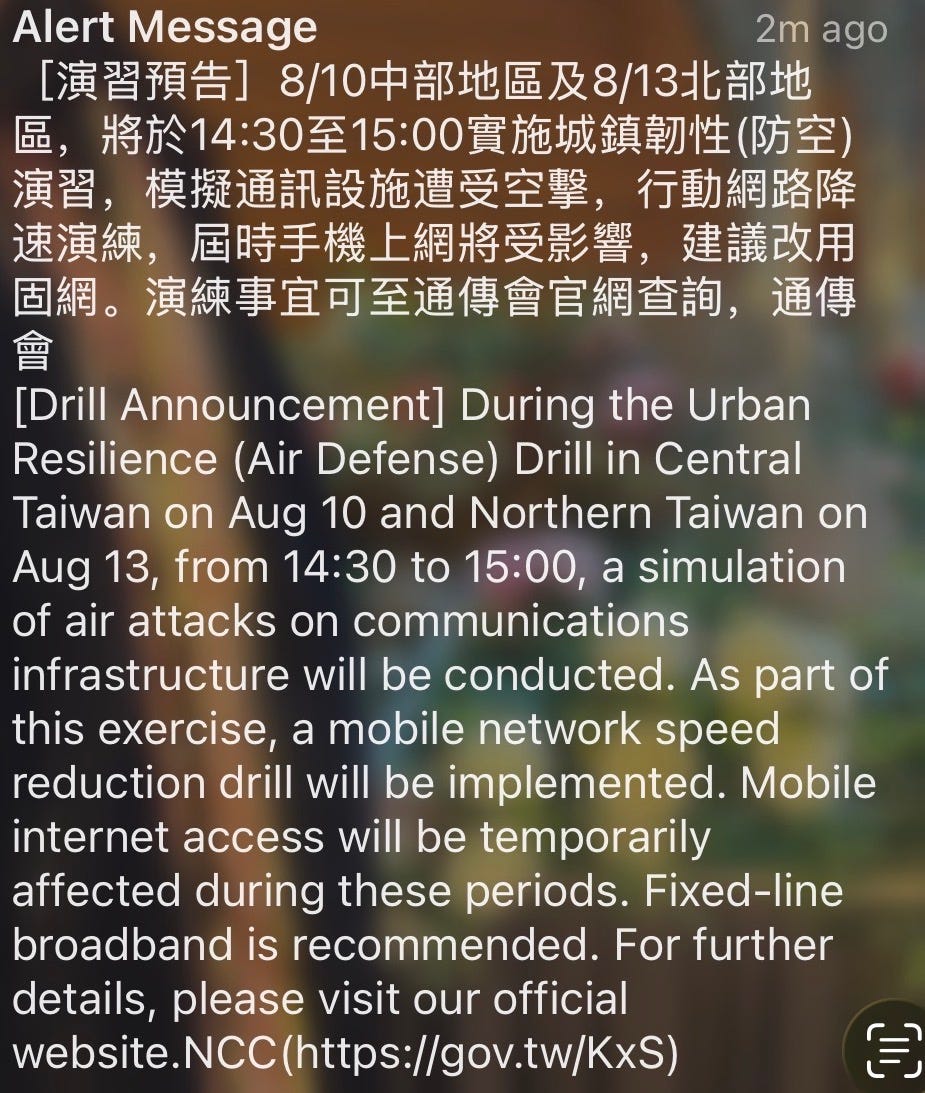
Taipei residents have been told that banking, taxi and internet services will go down in different parts of Taiwan on different dates to prepare the civilians for a future conflict.
If you want to use the power of OSINT skills, please consider signing up for the China OSINT course by Terton Intelligence: https://www.tertonintel.com/course
Han Kuang 42: Taiwan tests whether it can fight without a script
Taiwan’s Han Kuang 42 live fire exercise ran August 5 to 14, mobilizing more than 20,000 reservists in the island’s longest running annual drill cycle. What made this year different wasn’t scale. It was structure. For the first time in the drill’s 42 year history, commanders were not given the full exercise script in advance, forcing units to improvise when the simulated PLA “aggressor” deviated from expected patterns. That’s a direct response to war gaming assumptions that China would try to decapitate Taiwan’s command structure in the opening hours of a conflict.
The drills leaned hard into US style methods. “Backbriefing,” where subordinate officers restate a commander’s intent back to confirm they understood the mission, not just the words, was formally incorporated for the first time. President Lai Ching te was moved overnight from the Presidential Office to the Hengshan Military Command Center as part of the “Wanjun Plan,” rehearsing continuity of government under a decapitation scenario . Newly delivered M1A2T Abrams tanks and the just established Littoral Combat Command, which unifies anti ship missiles, coastal artillery, mobile radar, and drones under one structure, both participated for the first time
Civilian integration was the other big theme: commercial flatbed trucks moved tanks between regions overnight, a local printer supported a reserve command’s logistics, and mobile internet speeds were deliberately throttled in parts of the country to simulate wartime telecom disruption . Taiwan also ran anti airdrop drills in Taipei and Miaoli and an NBC decontamination exercise in Hualien simulating a chemical attack by “Chinese spies,” language that tells you where Taiwan’s threat model has moved: not just missiles, but infiltration .
The politics underneath the drills matter as much as the drills themselves. President Lai wanted a US$40 billion special defense budget. The opposition controlled legislature cut that to US$24.8 billion. A separate US$14 billion arms sales package remains stuck pending Trump’s approval, and Trump himself called Taiwan arms sales a “very good negotiating chip” with Beijing after his May summit with Xi Jinping, adding he didn’t want to “travel 9,500 miles to fight a war” over the island. Analysts like NTU’s Lev Nachman frame the deepened US Taiwan military to military coordination visible in Han Kuang as a “silver lining” precisely because the political signals from Washington have been so inconsistent.
The doctrinal shift nobody outside Taiwan is discussing
The most consequential change in Han Kuang 42 isn’t a weapon system. It’s a scenario change. For 42 years, Han Kuang built around 「灘岸決勝」(beach decisive battle): stop the PLA at the shoreline. This year’s exercise formally replaces that with 「多域拒止」(multi domain denial): air, sea, land, cyber, and civilian assets combined to deny the PLA a clean path to any objective, not just the beach. Deputy Chief of Staff Lt. Gen. Hou Chia lun put it directly: “In the past it was always beach decisive battle. Now we have moved to multi domain denial”.
Tied to that is the first ever designation of 「反封鎖」(anti blockade) as the exercise’s core scenario, displacing the traditional anti landing (反登陸) focus. Taiwan’s defense establishment now assesses that Beijing is more likely to try to strangle the island (mines, missile exclusion zones, routine air and sea harassment cutting off energy and food resupply) than to attempt a costly amphibious landing outright. Chief of the General Staff Admiral Mei Chia shu framed this to troops during “spiritual combat readiness week”: “What truly deters enemies is no longer symbolic weapons, but sustainable combat strength and resilience”.
Weapon systems fielded or debuted
Hsiung Feng II/III (雄風二型/三型) anti ship missiles. Forward deployed to Penghu for the first time on August 9, positioning shore based “carrier killer” firepower at the geographic center of the Strait, able to strike PLAN vessels approaching from either east or west. Development and production run through the National Chung Shan Institute of Science and Technology (CSIST), Taiwan’s state defense R&D house. Hsiung Feng II is a high subsonic sea skimming cruise missile. Hsiung Feng III is supersonic, built to compress an adversary’s reaction window to seconds at terminal approach .
Thunderbolt 2000 (雷霆2000) multiple launch rocket system. Another indigenous CSIST design, deployed to simulate suppressing an amphibious flotilla approaching the coast before troops reach the beach .
Land based Sky Sword II / TC 2 (陸射劍二). CSIST’s mobile short/medium range air defense missile, with a 15 km engagement envelope, drilled around Taoyuan International Airport and its beaches, designed for rapid “shoot and scoot” survivability and layered with Sky Bow III, Patriot, and Stinger to plug low altitude gaps .
HIMARS (海馬士). The Army’s 58th Artillery Command ran cross region reinforcement drills, moving HIMARS launchers into tactical firing position in poor weather to demonstrate high mobility, precision long range strike reinforcement between operational zones .
M1A2T Abrams tanks. Taiwan’s full order of 108 units arrived by April 2026. This exercise marked their live fire combat debut, assigned to the 584th Armored Brigade defending Taoyuan International Airport alongside Clouded Leopard 8x8 IFVs, with engineers building obstacles against airborne and special operations landings .
Mine warfare layer. Min Jiang class rapid minelaying ships (each carrying 32 to 64 indigenous Wan Hsiang naval mines) paired with the Army’s incoming Volcano mine laying systems (timed detonation, magnetic sensor land mines), giving Taiwan a rapid sea and land mining capability to delay a crossing force .
M3 Amphibious Bridge and Ferry System. Used on the Tamsui River to position oil barrels, obstruction nets, and pre placed C4 charges across the Danjiang and Guandu bridges, sealing river approaches to Taipei within four hours. Anti drone equipment was also installed to force enemy UAVs to crash into the river .
Combat patch systems of record. The official HK42 patch itself foregrounds three systems: HIMARS, the ALTIUS 600M loitering attack drone, and the Patriot PAC 3, Taipei’s own signal of which capabilities it considers central to this year’s doctrine .
New command architecture
The Littoral Combat Command (濱海作戰指揮部), stood up July 1, 2026, got its first full evaluation this cycle. It unifies anti ship missile brigades, coastal defense artillery, mobile radar, maritime surveillance, and unmanned systems under one headquarters, collapsing what used to be separate detection and strike chains into a single command loop. Its Penghu deployment of Hsiung Feng launchers is the clearest proof of concept so far.
Techniques and tradecraft
Backbrief (反向簡報). The US Army derived confirmation brief method, formally introduced this year: subordinates repeat mission intent back to commanders before execution, shifting decision authority downward under decentralized command .
“No script” continuous status exercises (無劇本/不預先腳本化). Commanders receive no advance plan. Unannounced crises (comms disruption, shifting resources, evolving enemy tactics) are injected in real time to force adaptive decision making rather than rehearsed responses.
Dispersed wartime production. The Armaments Bureau’s 202nd Arsenal rehearsed relocating out of Taipei, with civilian factories drilled on converting to munitions assembly under a mock emergency order .
Mobile network throttling. The first ever artificial reduction of mobile internet speeds nationwide, testing whether civilians and backup command channels can function once primary communications degrade.
Simulated infiltration/sabotage, not just artillery. The Hualien NBC decontamination drill modeled a chemical attack by enemy special agents (匪特/敵特工) rather than an artillery delivered strike, and required decontaminating personnel and vehicles within 30 minutes, reflecting a threat model centered on infiltration ahead of any overt strike.
Wanjun Plan continuity of government. President Lai was moved overnight from the Presidential Office to the Hengshan Military Command Center, rehearsing a decapitation strike contingency for national leadership.
Civilian military integration. Commercial flatbed trucks moved tanks across regions overnight, and a private printer supported a reserve command’s paperwork logistics: small but deliberate proofs that Taiwan’s whole of society defense concept extends into ordinary businesses.
One Chinese language OSINT source worth flagging for methodology: the PLA did not stage a matching large scale counter exercise on Han Kuang’s opening day, instead maintaining routine harassment levels (14 aircraft, 9 warships, and 7 civilian vessels detected around the Strait on August 5, with 6 aircraft crossing the median line). That’s read by Taiwanese analysts as a deliberate “companion presence,” neither escalating nor ceding the news cycle to Taipei’s drills.
Colby in Manila: the burden sharing pitch, out loud
Four days after Han Kuang’s live fire phase began, Under Secretary of War for Policy Elbridge Colby landed in Manila, his first Southeast Asia trip in the role, 18 months in . It’s the opening stop of a four country tour that also covers Jakarta, Bangkok, and Phnom Penh . His message, delivered at a Stratbase Institute forum, was built around one line that’s likely to become the tour’s epitaph: “We are looking for partners, not protectorates” .
Colby’s framing rests on “deterrence by denial along the First Island Chain,” the same geographic logic that underpins Taiwan’s own defense posture . He explicitly pushed back on reports that the US military is stretched thin after what he called “Operation Epic Fury,” insisting American maritime and aerospace capabilities remain “ready and capable” . He called the Philippines a “model ally,” met President Marcos at Malacañang, and pointed to concrete deliverables: a rotational deployment of four US Fast Response Cutters partnering with the Philippine Coast Guard, and an eight point US Philippine partnership plan for 2027 signed the week before his visit .
The backdrop is a genuinely tense moment for Manila. On July 20, a China Coast Guard member struck a Philippine Navy sailor in the head during a confrontation near Second Thomas Shoal, the kind of incident that keeps testing where the US Philippines mutual defense treaty’s tripwires actually sit . Colby’s answer wasn’t a new guarantee. It was a doctrine he called “strong, clear, but quiet”: heavy investment in forward posture and hard capability, paired with a diplomatic line to Beijing that avoids “peacocking.”
The connective tissue
Put side by side, Taipei and Manila are both being asked, implicitly or explicitly, to demonstrate they can absorb more of their own defense burden before Washington backs harder guarantees with hardware. Taiwan is doing this unscripted, with reservists and Abrams tanks and a legislature that won’t fully fund the ask. The Philippines is doing it with Coast Guard cutters and a “model ally” label that comes with real expectations attached. Colby’s language, “partners, not protectorates,” could just as easily be Washington’s unstated message to Taipei on the stalled US$14 billion arms package. The difference is that Taiwan doesn’t have a mutual defense treaty to fall back on if the burden sharing math doesn’t add up.
What to watch
Whether the US$14 billion Taiwan arms package moves before or after Xi’s September state visit to Washington.
How Colby’s stops in Jakarta, Bangkok, and Phnom Penh refine the “partners not protectorates” pitch for countries without a treaty ally’s leverage.
Whether China responds to Han Kuang 42’s conclusion with a compensatory show of force near Taiwan or the Second Thomas Shoal.
Whether Taiwan’s legislature revisits the special defense budget once Han Kuang’s after action reviews are public.
Reads:
Taking Taiwan’s democracy hostage — The Economist
In China, ‘Moles’ Are Leaking Official Secrets for Profit — WSJ
Taiwan’s 2027 defence spending to rise 16%, official media reports — Reuters
War Is Helping Chinese EVs Upend the Global Car Market — WSJ
Unmanned Equipment Deployed in Combat Training — PLA Media (please open consciously on a safe browser)