

Good morning. Beijing spent the past 48 hours doing three things at once: flexing ideological confidence on the world stage, tightening its legal grip on Taiwan’s identity, and quietly rebuilding a military command structure it spent a year gutting through purges. Add fresh reporting on general-level Russia-China defense coordination and a U.S. tech-security clampdown taking effect, and it’s a dense news cycle for anyone tracking the cross-strait and great-power dynamics. Here’s what matters.
Note: The newsletter edition was corrected and republished to remove additional links in the earlier edition.
1. Xi marks CCP’s 105th anniversary with global, not just domestic, messaging.
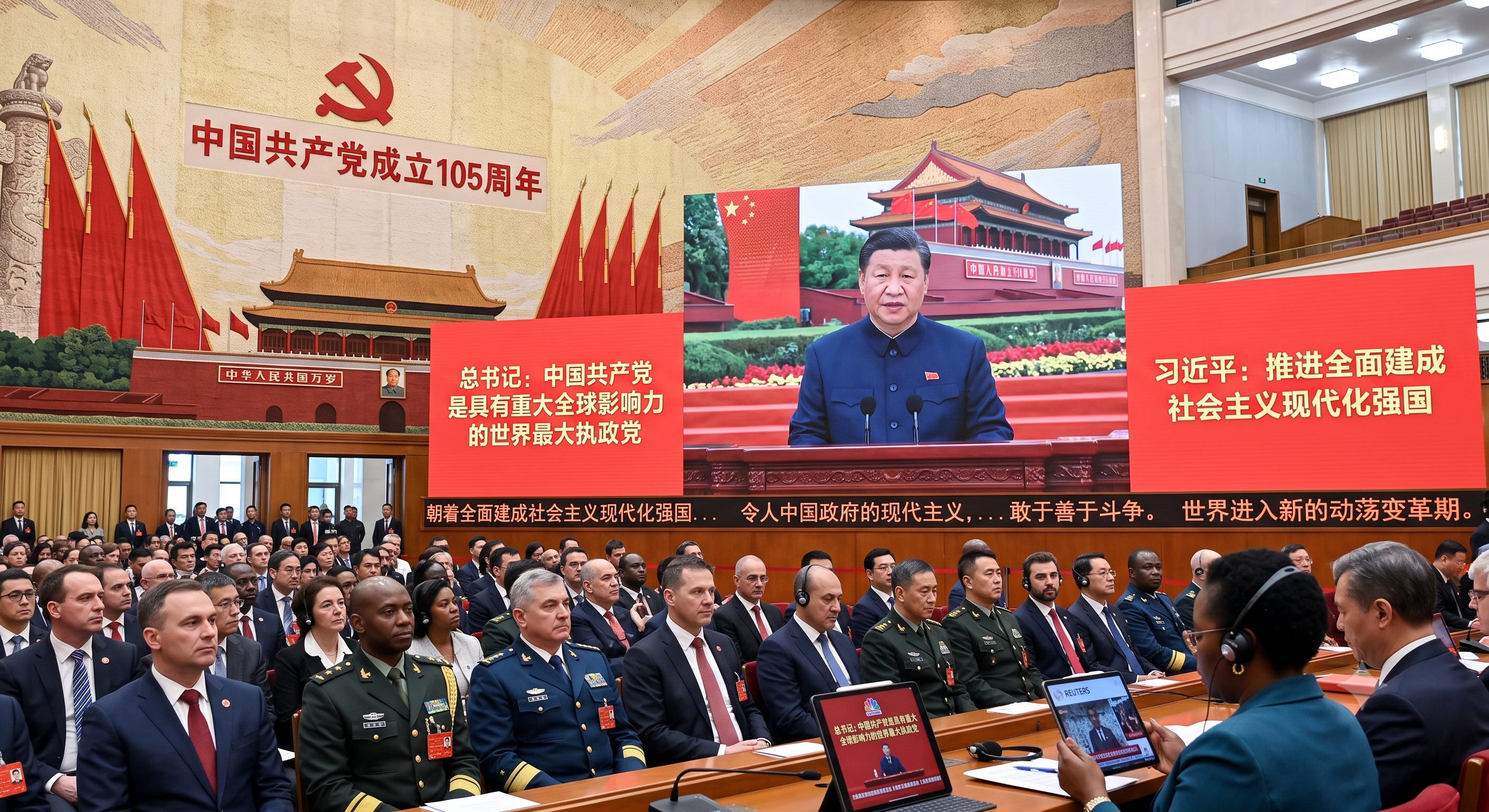
(Above image was generated using AI)
The Big Picture: Xi Jinping’s speech Wednesday at the Great Hall of the People struck a more outward-looking tone than his past anniversary addresses, casting the CCP as “the world’s largest ruling party with significant global influence” rather than focusing narrowly on domestic “national rejuvenation”. He simultaneously reaffirmed Beijing’s hardline stance on Taiwan, calling “reunification” the party’s “unwavering historical responsibility”.
The Details:
The Catalyst: The roughly 40-minute address, delivered July 1 to mark the party’s 1921 founding, opened with Xi invoking “回顾我们党走过的光辉历程” (”looking back on the party’s glorious journey”) and calling on the whole party and people to advance “朝着全面建成社会主义现代化强国、实现中华民族伟大复兴的宏伟目标奋勇前进” (”toward the grand goal of fully building a modern socialist power and achieving the great rejuvenation of the Chinese nation”).
The Scope: Xi argued the CCP’s durability comes from qualities “其他政党和政治力量无可比拟” (”incomparable to any other political party or force”), listing traits such as “矢志追求真理” (unwavering pursuit of truth), “深深植根人民” (deeply rooted in the people), and “敢于善于斗争” (daring and skilled at struggle).
The Themes: He warned that “世界进入新的动荡变革期,人类又一次站在何去何从的十字路口” (”the world has entered a new period of turbulence and change, and humanity again stands at a crossroads”), and stressed “强国必须强军” (”a strong nation must have a strong military”), calling for accelerating efforts to build “世界一流劲旅” (a “world-class force”).
Between the Lines: On internal discipline, Xi used sharper language than in prior years, demanding the party “坚决清除一切损害党的先进性和纯洁性的因素、清除一切侵蚀党的健康肌体的病毒” (”resolutely eliminate all factors that damage the party’s advanced nature and purity, and purge all viruses that erode the party’s healthy body”). Taiwan’s government dismissed the Taiwan portion of the speech as “repeating old talking points”.
The Bottom Line: Xi is projecting confidence on two fronts at once: positioning the CCP as a global governance model while doubling down on Taiwan rhetoric and internal “self-revolution” language, signaling Beijing sees no need to soften its core positions even as it courts broader international legitimacy.
2. Beijing begins rebuilding its gutted military high command
The Big Picture: After more than a year of unprecedented purges left China’s Central Military Commission reduced to just Xi and loyalist Zhang Shengmin, reporting indicates Beijing has now started recomposing the commission, signaling Xi may be ready to move past the purge phase and rebuild the PLA’s top leadership structure.
The Details:
The Catalyst: The CMC’s collapse accelerated after Gen. Zhang Youxia, then the top vice-chairman and second only to Xi in the military hierarchy, was placed under investigation in January alongside Gen. Liu Zhenli, following the earlier expulsions of Gen. He Weidong and Navy Adm. Miao Hua.
The Scope: At its low point, the six-member CMC operated with only Xi as chairman and Zhang Shengmin, the military’s former anti-corruption chief, as vice-chairman, a situation analysts described as “the total annihilation of the high command”.
The Rebuild: Zhang Shengmin was formally elevated to vice-chairman in October 2025 following the Fourth Plenary Session, marking the first concrete step toward reconstituting the body after the wave of dismissals.
Between the Lines: Analysts had questioned whether Xi would wait until the 2027 Party Congress to fill the remaining vacant CMC seats. Signs that recomposition is underway now suggest he may not be waiting for the full congressional cycle to restore operational command capacity.
The Bottom Line: A CMC running on two members for over a year raised real questions about PLA operational readiness and chain-of-command clarity during a period of heightened Taiwan tension. Moves to fill out the command structure suggest Xi has finished consolidating loyalty and is shifting toward restoring functional military leadership, worth watching closely for who gets promoted next and what it signals about Taiwan contingency planning.
3. China’s “ethnic unity” law goes live, with a long arm aimed at Taiwan
The Big Picture: Beijing’s new Ethnic Unity and Progress Promotion Law took effect July 1, formally extending Beijing’s assimilationist framework beyond its 56 recognized ethnic groups to explicitly claim Taiwanese and Hong Kong residents as part of a single “Chinese nation,” while also asserting jurisdiction over anyone abroad who challenges that. Taiwan responded with “strong condemnation,” warning the law effectively criminalizes dissent by foreigners.
The Details:
The Catalyst: Passed by China’s National People’s Congress on March 12 and formally activated July 1, the 65-article law mandates Mandarin as the primary language in education and public life and requires schools to instill loyalty to the Communist Party.
The Scope: Article 63 extends liability to organizations and individuals outside mainland China, explicitly including Taiwan and Hong Kong compatriots and overseas Chinese, who are deemed to “undermine ethnic unity” or “incite ethnic division”.
The Response: Taiwan’s Mainland Affairs Council and Foreign Ministry say the law could compel citizens toward pro-unification positions or expose them to prosecution simply for critical commentary, calling it a form of long-arm jurisdiction.
Between the Lines: Beijing has openly defended its right to target people overseas under the law, removing any ambiguity about its extraterritorial intent just as concerns from the UN and rights groups mount.
The Bottom Line: This is a legal weaponization of identity politics. Beijing is now trying to codify Taiwanese “Chinese-ness” into domestic law, giving itself a formal pretext to pursue critics globally, not just at home.
4. Wang Yi tells Rubio to handle Taiwan with “utmost caution”
The Big Picture: In a Tuesday phone call, China’s top diplomat Wang Yi issued a pointed warning to Secretary of State Marco Rubio, saying “a slight move on the Taiwan issue could affect the whole situation.” That’s a sign Beijing is watching for any perceived shift in U.S. posture even amid a fragile trade truce.
The Details:
The Catalyst: The call, disclosed by China’s Foreign Ministry on Wednesday, came as both sides continue trying to manage risks in the broader relationship.
The Scope: Wang’s language framed Taiwan as the single most destabilizing variable in the bilateral relationship, above trade or tech disputes.
Between the Lines: The timing, one day after China’s ethnic unity law took effect and around Xi’s anniversary speech, suggests Beijing is bundling legal, rhetorical, and diplomatic pressure on Taiwan into a coordinated push rather than isolated moves.
The Bottom Line: Beijing is signaling that any perceived U.S. tilt toward Taipei, whether arms sales, official contacts, or rhetoric, carries outsized risk to the broader U.S.-China relationship right now.
5. Reuters exposes top-level Russia-China military training pact
The Big Picture: New Reuters reporting shows China’s covert military training of Russian forces last year was personally approved by Russian Defense Minister Andrei Belousov and directly involved at least four Russian and Chinese generals, a level of high-level sign-off that goes far beyond the rank-and-file training previously disclosed. The finding deepens alarm in Europe that Beijing’s support for Moscow’s war effort is institutionalized at the top of both militaries, not incidental.
The Details:
The Catalyst: A classified Russian document seen by Reuters references an internal decree issued by Belousov in August 2025, under which a Russian armed forces delegation traveled to China to train at PLA facilities.
The Scope: Documents name senior officers on both sides, including Russian Colonel General Rustam Muradov, who led the delegation, and Chinese Major General Li Jinsun, head of the PLA’s Military Academy of Radiological, Chemical and Biological Defence. One course, held in Beijing in November, focused on radiological, chemical, and biological protection.
The Signatories: The training framework was underpinned by a July 2 agreement signed by Russian Major General Rustam Khusainov and Chinese Senior Colonel Sun Dayun, according to the officials.
Between the Lines: This builds on an earlier Reuters report that China secretly trained about 200 Russian personnel in drone warfare and electronic warfare, some of whom later fought in Crimea and Zaporizhzhia. Beijing has repeatedly denied direct involvement, calling the claims “entirely unfounded,” while the Kremlin has separately dismissed related reporting as misinformation.
The Bottom Line: The generals-level oversight described in the documents suggests Moscow-Beijing defense cooperation has moved from informal exchanges to an approved, institutional framework, exactly the kind of integration Western officials have long warned would blur the line between “no-limits partnership” rhetoric and direct battlefield support.
6. FCC’s expanded Chinese tech ban kicks in
The Big Picture: The FCC’s expanded ban on importing legacy Huawei, ZTE, Hikvision, Dahua, and Hytera equipment takes effect in early July, closing a loophole that let older, pre-2022 models keep entering the U.S. market.
The Details:
The Catalyst: The FCC voted June 26 to widen its original 2022 restriction, which had only barred new models from the five blacklisted Chinese firms.
The Scope: The rule targets equipment used in public safety, government facilities, and critical-infrastructure surveillance, citing electronic-espionage risk.
The Penalties/Limits: Previously purchased equipment already in use is grandfathered in, and the rule doesn’t retroactively cover older drone or router models.
Between the Lines: This closes a workaround companies had used to keep buying legacy versions of banned gear, reflecting Washington’s broader push to scrub Chinese hardware from sensitive networks link by link.
The Bottom Line: The U.S. is tightening, not just maintaining, its tech-decoupling perimeter. The security-driven restrictions on Chinese hardware are expanding even as trade talks stay in a cooling-off period.
7. Chinese Coast Guard patrols east of Taiwan stay a live irritant
The Big Picture: Beijing’s decision to send Coast Guard vessels into waters east of Taiwan, a maneuver Taipei calls provocative, underscores that gray-zone pressure hasn’t paused even as diplomatic channels stay open.
The Details:
The Catalyst: Chinese state media described the patrol as a special maritime traffic law-enforcement operation, launched in apparent response to a joint Japan-Philippines announcement.
The Scope: Four Chinese vessels entered waters Taiwan considers restricted before being tracked and expelled by Taiwan’s Coast Guard.
Between the Lines: Taiwan’s Defense Minister Wellington Koo confirmed the military is coordinating closely with the Coast Guard, treating even non-military patrols as a security-relevant signal requiring intelligence sharing.
The Bottom Line: Beijing continues to use ambiguous, sub-military maritime assets to probe and normalize presence around Taiwan. That pattern is becoming a baseline stressor rather than an isolated incident.
Thank you for reading!