

Hello Readers,
Before we begin: This briefing is now part of Terton Intel, my new intelligence and analysis venture. If you find this useful, you can explore more at tertonintel.com.
The Takeaway
Three sharp developments this week show Beijing pressing on multiple fronts while its own elite fractures. First, Moonshot AI released Kimi K3, the world’s largest open-weight AI model, which benchmarks near top U.S. systems at a fraction of the cost, compressing the U.S.-China performance gap to roughly six months. Second, Papua New Guinea ordered Taipei’s representative office to close, prompting Taiwan’s foreign minister to announce a formal review of economic ties, including natural-gas purchases. Third, China expelled Politburo member Ma Xingrui in one of the most serious corruption cases of Xi’s third term, signaling that even the highest technocrats are not immune. Together, they highlight China’s simultaneous advances in tech competition and diplomatic isolation, even as internal discipline tightens.
1. Moonshot AI’s Kimi K3 narrows U.S. lead with open-weight breakthrough
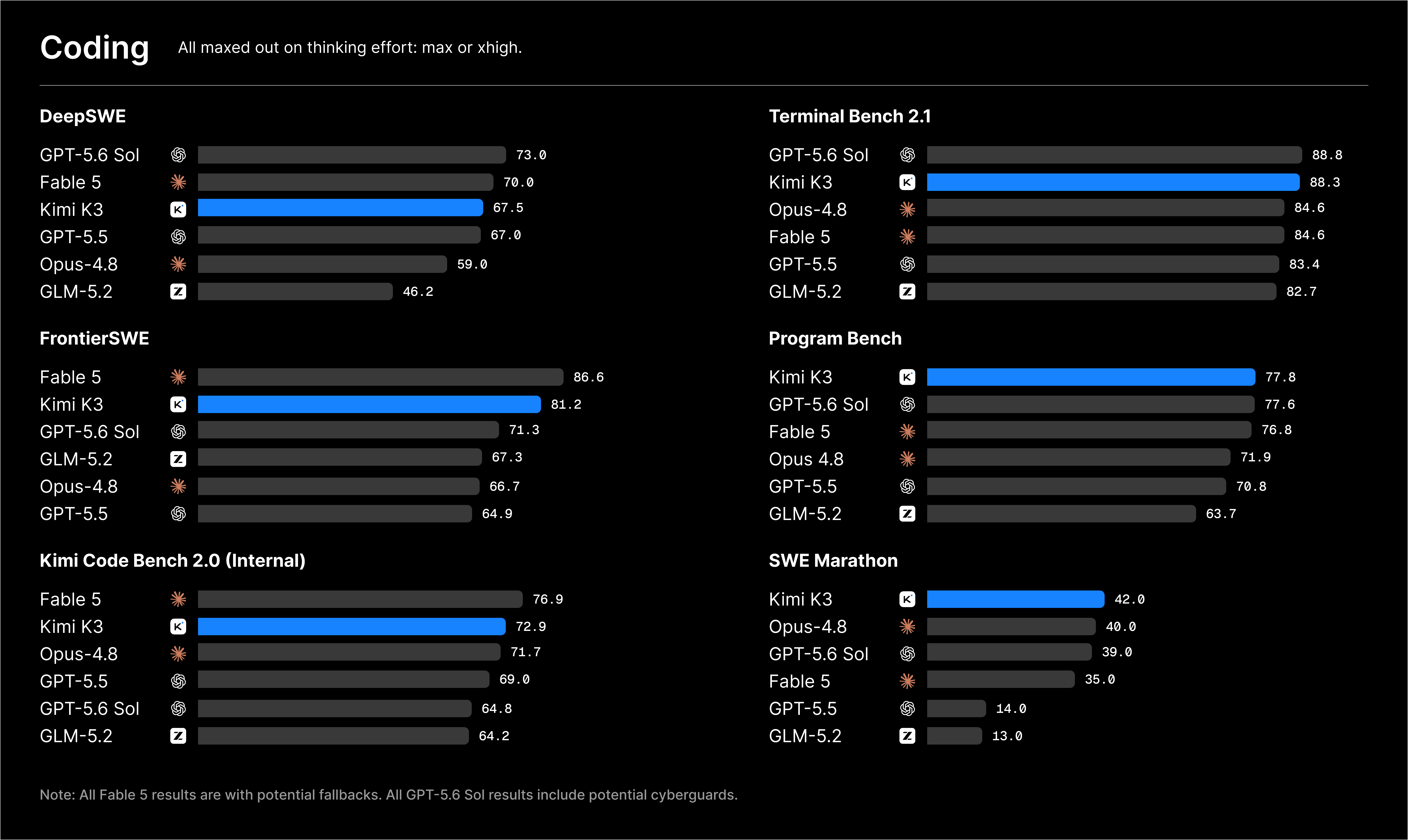
Kimi K3 compared to other models (Source: Moonshot AI)
The Big Picture: Beijing-based Moonshot AI unveiled Kimi K3 on July 16-17, calling it the largest open-weight model to date (2.8 trillion parameters, 1M-token context). Independent tests place it in the frontier tier alongside Anthropic’s Claude Fable 5 and ahead of several OpenAI models on key tasks, accelerating the erosion of America’s technological edge.
The Details:
• The Release: K3 is fully open-weight, with full model weights scheduled for July 27. It features advanced long-context handling (Kimi Delta Attention for up to 6.3x faster decoding) and was timed to coincide with President Xi Jinping’s address at the World AI Conference in Shanghai.
• Performance Data: Artificial Analysis ranks K3 fourth overall but ahead of Anthropic’s Opus 4.8 and several GPT-5 variants on its Intelligence Index. On terminal-style agentic coding (Terminal Bench 2.1), K3 scores 88.3, slightly ahead of Claude Opus 4.8 and within half a point of GPT-5.6 Sol. It also leads on some coding and front-end benchmarks.
• Cost Advantage: API pricing is about $3/$15 per million input/output tokens, below comparable U.S. frontier models on a per-task basis, making Chinese open systems increasingly attractive to global developers.
• Market Signal: Nasdaq fell roughly 1% on July 17 as investors trimmed AI-chip names (Nvidia, Intel) on fears of faster Chinese catch-up.
Between the Lines: Stanford’s Graham Webster notes the U.S.-China performance gap has compressed to about six months. Experts warn a fully matching open Chinese model is now a near-term prospect, complicating U.S. export-control strategy and the economics of closed, capital-intensive American systems. On the same day, Xi called for AI as “a symphony of international cooperation” rather than domination by any single country.
Why It Matters: Open-weight Chinese models are turning U.S. chip restrictions into a partial own-goal. By delivering near-frontier performance at dramatically lower cost and with full openness, China is both undercutting American commercial advantages and creating a global developer ecosystem less dependent on U.S. closed models. Downstream risks include faster diffusion of advanced capabilities for dual-use applications and greater difficulty for Washington in maintaining a decisive technological lead.
2. PNG closes Taiwan office; Taipei escalates with gas-import review
The Big Picture: Papua New Guinea’s July 16 order to shut Taipei’s representative office in Port Moresby triggered a concrete Taiwanese counter-move on July 18: Foreign Minister Lin Chia-lung announced a formal reassessment of economic ties, specifically including natural-gas purchases.
The Details:
• The Catalyst: PNG Foreign Minister Justin Tkatchenko declared the office must “immediately cease operations”, citing the One-China principle and the 50th anniversary of PNG-PRC relations; Taiwan said the decision came without prior consultation.
• Beijing’s Response: Chinese Foreign Ministry spokesperson Lin Jian publicly “highly appreciated” the move.
• Taipei’s Escalation: After initially protesting and insisting the office would continue operating, Lin said on July 18 that Taiwan is reviewing economic relations with PNG, specifically including LNG imports, where Taiwan is a significant buyer.
• U.S. Position: The State Department expressed deep concern, calling the closure “another example of Beijing’s intimidation” of Taiwan and its partners.
Why It Matters: This is a textbook application of Beijing’s isolation strategy using bilateral leverage and anniversary timing. Taiwan’s decision to put gas purchases on the table marks its first serious attempt to impose commercial costs in response. If followed through, it could raise the price for other Pacific states considering similar steps. The episode shows diplomatic setbacks can now trigger measurable economic friction.
3. Ma Xingrui’s downfall: Politburo purge exposes limits of Xi’s technocratic elite
The Big Picture: On July 14, China expelled Ma Xingrui from the Communist Party, making him the third sitting Politburo member purged since 2025. The case, announced via Xinhua and carried on the front page of People’s Daily on July 15, signals that even Xi’s most trusted technocrats are not immune from the anti-corruption drive.
The Details:
Official Charges: The Central Commission for Discipline Inspection (CCDI) accused Ma of:
• “丧失理想信念和政治立场,背弃党的宗旨和初心使命” (losing ideals and political stance, abandoning the party’s purpose and original mission)
• “搞权色、钱色交易” (engaging in power-for-sex and money-for-sex transactions)
• “大搞家族腐败” (large-scale family corruption)
• “违规收受礼品、礼金,帮助亲属低价购房” (illegally accepting gifts and money, helping relatives buy houses at discounted prices)
The official announcement concluded: “马兴瑞完全背离党性原则,严重违背党中央对高级干部提出的政治要求,其行为严重违反党的纪律,构成职务违法并涉嫌受贿犯罪,且在党的十八大后不收敛、不收手,性质极其严重,影响极其恶劣” (Ma completely abandoned party principles, seriously violated political requirements for senior cadres, and his behavior was extremely serious in nature with enormous social impact).
How It Was Treated: The July 15 People’s Daily placement signals this was treated as a major disciplinary case, but notably the language avoided terms like “forming factions” or “undermining party unity” that appear in military purges such as Zhang Youxia and He Weidong. Instead, the emphasis was on corruption, family misconduct, and abuse of power, suggesting a structural corruption case rather than a political conspiracy.
Timeline: Ma was placed under investigation in April 2026, abruptly stepped down as Xinjiang party secretary in July 2025, and disappeared from public view by late 2025. He skipped the Two Sessions in March 2026, deepening speculation about his fall.
Why It Matters: Ma’s case shows three things. First, Xi’s anti-corruption drive is now penetrating the highest levels of the Politburo, not just the military or lower ranks. Second, the focus on family corruption and sex-for-power transactions mirrors language used in earlier high-profile cases, suggesting a playbook for dismantling even senior figures. Third, the absence of overtly political language (no mention of factions or disloyalty) suggests Ma was treated as a corruption case rather than a purge, which may limit the political fallout but still signals that Xi’s inner circle is not untouchable.
For Xi, this is both a strength and a vulnerability. It demonstrates he can still discipline the elite, but it also exposes how deeply corruption has penetrated his own handpicked technocrats. The message to other officials is clear: even rocket scientists turned Politburo members are not safe.
Bottom Line
China is advancing on both the technology frontier (open-weight models closing the gap rapidly) and the diplomatic front (shrinking Taiwan’s Pacific footprint), even as its own elite faces unprecedented internal discipline. The Kimi K3 release is the more strategically consequential long-term development; the PNG episode is the sharper near-term test of whether Taiwan can impose costs; and the Ma Xingrui case reveals the fragility of Xi’s technocratic elite.
Watch for: actual changes in Taiwan-PNG energy contracts; independent verification of Kimi K3’s sustained performance after the full weights drop on July 27; any further Pacific capitals under parallel pressure; and whether additional Politburo members face investigation before the 2027 Party Congress.